Industrial automation equipment often requires controlled linear movement for pushing, pulling, lifting, pressing, clamping, positioning, and product transfer. While pneumatic cylinders remain common in many machines, electric cylinder actuators provide an alternative when applications require programmable movement, adjustable speed, accurate positioning, or easier integration with electronic control systems.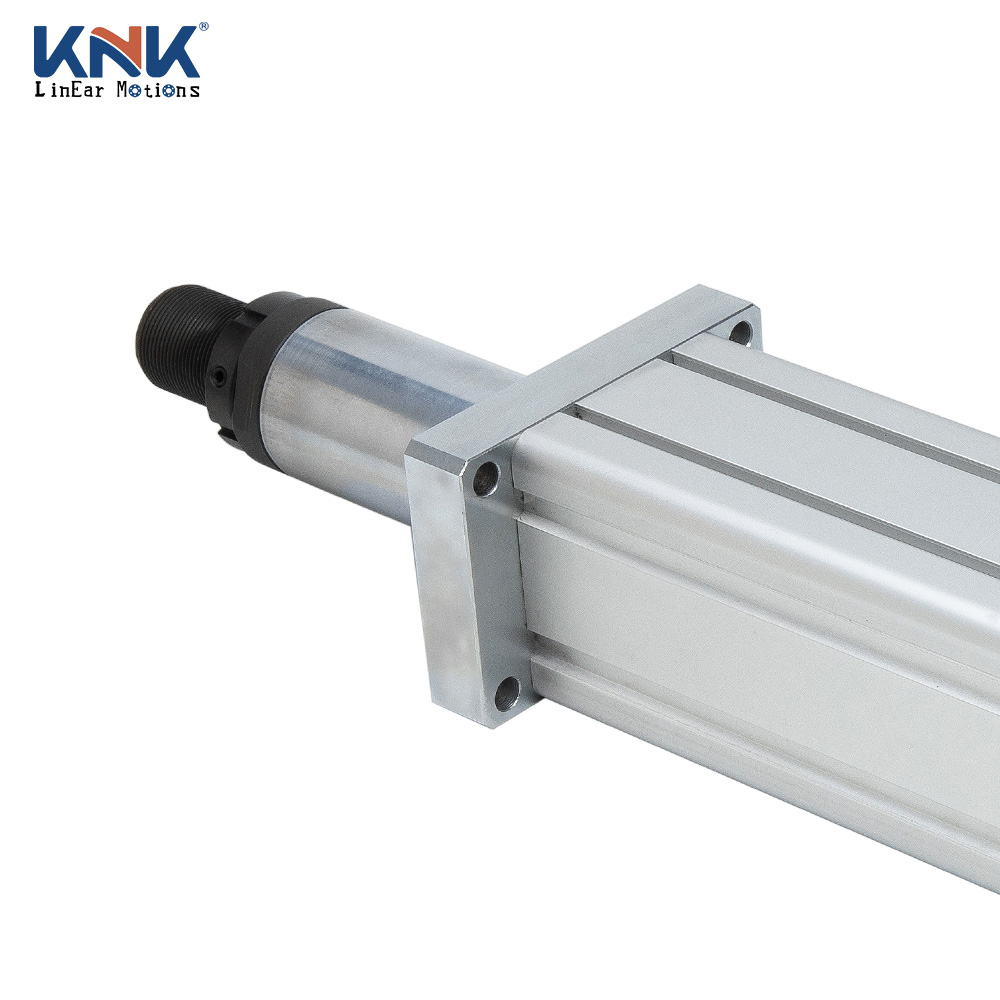
An electric cylinder actuator converts the rotary movement of an electric motor into linear movement. Depending on the mechanical configuration, it can provide controlled thrust and repeatable motion for a wide range of automated machines.
For OEM machine builders and automation integrators, standard actuators may not always fit the application. A custom electric cylinder actuator can be designed according to the required stroke, force, speed, payload, mounting dimensions, motor, feedback, and control requirements.
Electric cylinder actuators are electromechanical linear actuators that use an electric motor and mechanical transmission to generate linear motion.
A typical electric cylinder actuator may include:
The basic operating principle is:
Motor → Transmission → Screw → Linear Rod Movement
When the motor rotates, the transmission mechanism converts rotary motion into controlled linear displacement.
This allows the actuator to perform functions such as:
One of the main advantages of electric cylinder actuators is their ability to provide controlled motion.
Depending on the motor and control system, users can control:
This makes electric actuators suitable for machines that require multiple motion positions rather than simple end-to-end movement.
Stroke length is one of the most important parameters when selecting an electric cylinder actuator.
Different machines may require completely different travel distances.
A custom actuator can be designed around the required:
For OEM applications, customizing the stroke can help the actuator fit directly into the machine design.
Electric cylinder actuators can be selected according to the required thrust.
They can be used for:
The required force should be calculated according to payload, friction, acceleration, mounting orientation, and mechanical resistance.
For vertical applications, the weight of the moving load must also be considered.
Electric cylinder actuators can provide controlled linear speed.
For example, a machine may require:
Fast Approach → Slow Positioning → Hold → Fast Return
The motion profile can be configured according to the application's requirements.
This is particularly useful for assembly, pressing, positioning, and inspection equipment.
Electric cylinder actuators can be integrated with electronic motion-control systems.
Depending on the configuration, they can work with:
This allows the actuator to move to predefined positions instead of relying only on mechanical end stops.
Electric cylinder actuators can be designed for different installation orientations.
Common configurations include:
Mounting interfaces can also be customized for integration with OEM equipment.
For many automation projects, engineers need to decide between electric and pneumatic actuation.
| Feature | Electric Cylinder Actuator | Pneumatic Cylinder |
|---|---|---|
| Motion Control | Highly programmable | Generally simpler |
| Position Control | Excellent | Requires additional components |
| Speed Control | Programmable | Adjustable |
| Multiple Positions | Easy to implement | More complex |
| Air Supply | Not required | Required |
| Electronic Integration | Excellent | Requires additional control components |
| Typical Application | Positioning, pressing, lifting | Fast repetitive actuation |
| Maintenance | Mechanical/electrical | Air system and seals |
Neither technology is universally better. The choice depends on the required force, speed, positioning, duty cycle, control method, and machine environment.
Electric cylinder actuators and linear modules both create linear motion, but their mechanical structures are different.
An electric cylinder normally uses a rod-type output, making it suitable for pushing, pulling, lifting, and pressing.
A linear module normally moves a carriage along a guide rail, making it suitable for longer travel and guided horizontal movement.
Suitable for:
Suitable for:
For a custom machine, the decision should consider the complete mechanical structure rather than simply comparing maximum specifications.
Electric cylinder actuators can perform controlled movements during automated assembly.
Typical applications include:
A programmable actuator can adjust its movement according to the assembly process.
Electric cylinder actuators can be used when controlled linear force is required.
Potential applications include:
For these applications, engineers should consider not only maximum force but also the required force profile and cycle time.
Electric cylinder actuators can provide controlled vertical movement.
Applications include:
Vertical applications require careful evaluation of payload, stroke, speed, acceleration, and load-holding requirements.
Electric cylinder actuators can be used as linear movement axes within pick-and-place machines.
They can move:
For long and high-speed horizontal travel, an electric cylinder can also be combined with a belt driven linear module or other linear motion system.
Electric actuators can perform controlled product transfer between different positions.
For example:
Conveyor → Electric Cylinder → Transfer Position → Processing Station
The actuator can push or pull products into a specific location.
This is useful for automated transfer and handling equipment.
Inspection systems may require cameras, sensors, or inspection fixtures to move between predefined positions.
Electric cylinder actuators can provide controlled movement for:
Multiple programmed positions can be used when different product sizes or inspection points need to be handled.
Electric cylinder actuators can be integrated into packaging equipment for:
The actuator should be selected according to the required force, stroke, speed, and cycle frequency.
Electric cylinder actuators can work together with conveyor systems to perform automated handling operations.
For example:
Conveyor → Stop → Position → Electric Cylinder → Transfer
The actuator can push products from the conveyor into another processing position.
It can also be used for automated stops, gates, diverters, and positioning mechanisms.
Standard products may not always meet the mechanical requirements of an OEM machine.
A custom electric cylinder actuator can be configured according to the customer's actual application.
Customization may include:
The required travel distance.
The required pushing or pulling force.
The required linear movement speed.
Possible motor configurations include:
The mounting interface can be customized for the machine structure.
Depending on the positioning requirements, feedback components such as encoders or sensors can be integrated.
Electric cylinder actuators can be combined with other linear motion components to create customized multi-axis systems.
For example:
X-Axis Belt Driven Linear Module + Y-Axis Linear Module + Z-Axis Electric Cylinder
The X and Y axes can provide horizontal positioning, while the electric cylinder provides vertical movement.
This configuration can be useful for:
Using different motion technologies for different axes can help engineers optimize the system according to each axis's specific requirements.
Before selecting an electric cylinder actuator supplier, OEM customers should define several key parameters.
Determine the required linear travel.
Calculate the maximum required thrust based on the payload and mechanical resistance.
Determine how quickly the actuator must complete the movement.
Consider how frequently the actuator will operate.
Horizontal, vertical, or inclined installation can significantly affect the required actuator specifications.
Determine whether the application needs:
Consider:
A custom electric linear actuator manufacturer will normally evaluate the complete application.
A typical design process may include:
Application Requirements → Force Calculation → Stroke Selection → Motor Matching → Mechanical Design → Prototype → Testing → Production
The manufacturer may also evaluate:
This application-based approach is especially useful for OEM customers with non-standard requirements.
When requesting a quotation for an electric cylinder actuator, provide:
Providing these details allows the manufacturer to recommend a configuration based on the actual machine.
Electric cylinder actuators are widely applicable to:
For standard applications, an off-the-shelf electric actuator may be sufficient.
For OEM equipment, however, the actuator often needs to match the complete mechanical and electrical system.
A capable manufacturer should be able to support:
This can help reduce the engineering work required from the machine builder and improve compatibility with the final equipment.
Electric Cylinder Actuators provide controlled linear movement for industrial automation applications that require pushing, pulling, lifting, pressing, clamping, or positioning.
Their main features include programmable motion, adjustable speed, controlled force, customizable stroke, positioning capability, flexible mounting, and integration with PLC and motion-control systems.
They can be used in automated assembly, pick and place, material handling, inspection, packaging, lifting, pressing, and conveyor transfer systems.
For OEM machine builders, customization is often the key advantage. Stroke, force, speed, motor, mounting interface, sensors, feedback, and control requirements can all be considered during the design process.
The right electric cylinder actuator should be selected according to the complete application rather than a single specification. Payload, stroke, force, speed, acceleration, cycle time, orientation, positioning requirements, and working environment all influence the final configuration.
For specialized automation equipment, a custom electric cylinder actuator can provide a compact and controllable motion solution that integrates with the machine's overall automation architecture.