Modern automation equipment requires precise and repeatable linear movement for positioning, feeding, pushing, pulling, lifting, clamping, and product transfer. In applications where controlled incremental movement is required, a Stepper Motor Actuator can provide a practical motion solution.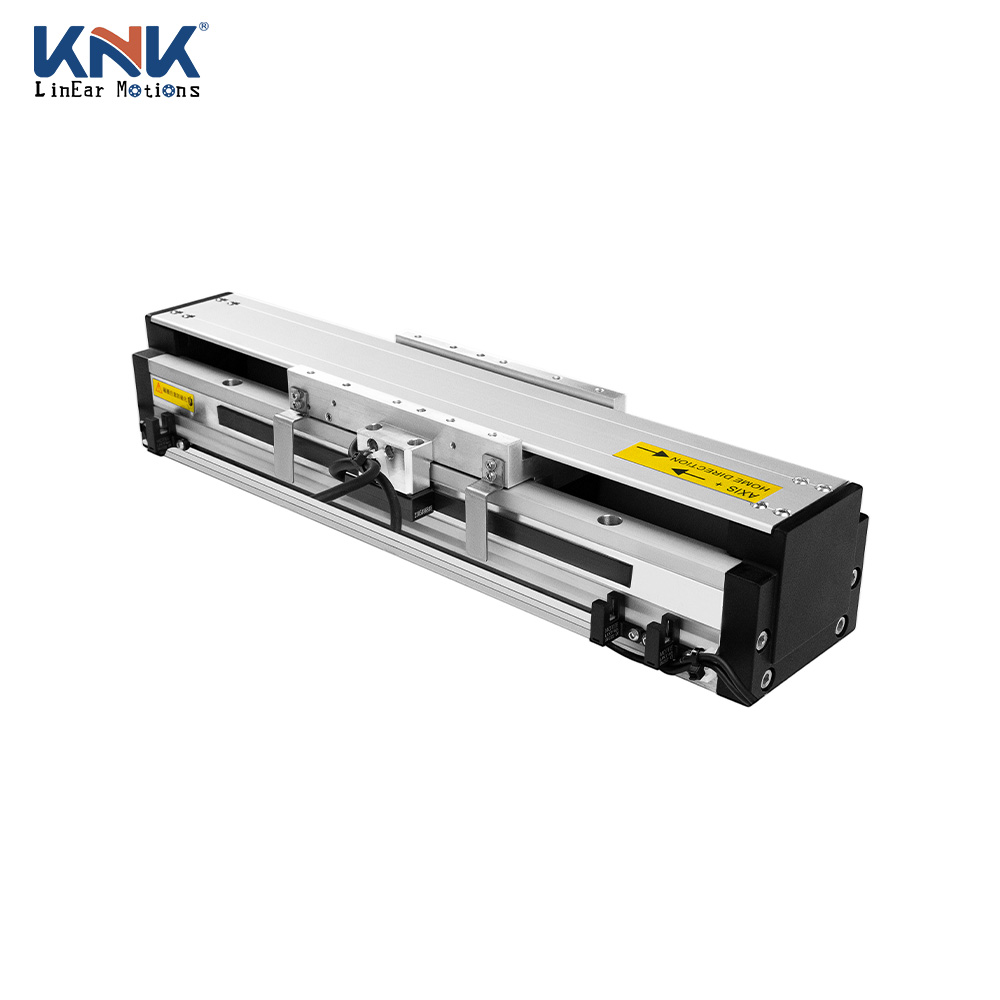
A stepper motor actuator combines a stepper motor with a mechanical transmission mechanism to convert rotary motion into controlled linear movement. Depending on the design, the actuator can use a lead screw, ball screw, belt, or another transmission method.
For OEM machine builders and automation integrators, the actuator can be customized according to stroke, thrust force, speed, motor size, mounting configuration, positioning requirements, and control method.
A stepper motor actuator is an electromechanical motion device that uses a stepper motor to generate controlled mechanical movement.
A typical linear configuration includes:
The basic operating principle is:
Electrical Pulse → Stepper Motor Rotation → Mechanical Transmission → Linear Motion
The stepper motor rotates in defined increments. The transmission mechanism then converts the rotation into linear displacement.
This makes the technology suitable for applications where repeatable incremental movement is required.
Stepper motors divide rotation into defined steps.
This allows the actuator to move in controlled increments and makes it suitable for applications requiring repeatable positioning.
Typical applications include:
The actual positioning performance depends on the motor, transmission, mechanical accuracy, load, control system, and operating conditions.
Stepper motor actuators can be controlled through electrical pulse signals.
A controller can determine:
This can simplify the control architecture for machines that do not require a closed-loop servo system.
For applications requiring feedback or higher control performance, an encoder can also be considered.
Different machines require different travel distances.
A custom stepper motor actuator can be designed according to the required stroke and available installation space.
Important parameters include:
Custom stroke options are particularly useful for OEM equipment with non-standard mechanical layouts.
The speed of a stepper motor actuator can be controlled by adjusting the pulse frequency.
Different operating stages can use different speeds.
For example:
Fast Movement → Deceleration → Slow Positioning → Stop
This can be useful for automated positioning and transfer applications.
However, the achievable speed depends on factors such as motor torque, load, screw lead, acceleration, and operating conditions.
When energized, a stepper motor can generate holding torque.
This can be useful for applications where the actuator needs to maintain a position during a process.
However, vertical applications and safety-critical loads should not rely solely on motor holding torque. A suitable mechanical holding or braking solution may be required depending on the application.
Stepper motor actuators can be configured with different motor sizes according to the required torque and load.
Motor selection depends on:
A custom actuator manufacturer can match the motor and transmission according to the complete application.
Both stepper and servo systems can be used for automated positioning, but their characteristics differ.
| Feature | Stepper Motor Actuator | Servo Actuator |
|---|---|---|
| Control | Pulse-based | Closed-loop commonly used |
| Position Feedback | Optional | Common |
| System Complexity | Relatively simple | Higher |
| Cost | Often lower | Generally higher |
| Low-Speed Control | Good | Excellent |
| High-Speed Performance | Application dependent | Generally strong |
| Overload Detection | Limited without feedback | Available through feedback/control |
| Typical Application | Positioning, feeding, adjustment | High-performance motion |
A stepper actuator can be an attractive choice when the application requires controlled positioning without the full complexity of a servo system.
Stepper motor actuators and pneumatic cylinders are used for different motion requirements.
| Feature | Stepper Motor Actuator | Pneumatic Cylinder |
|---|---|---|
| Position Control | Excellent | More limited |
| Multiple Positions | Easy | Requires additional components |
| Speed Control | Programmable | Adjustable |
| Air Supply | Not required | Required |
| Electronic Control | Easy | Requires pneumatic control |
| Force | Application dependent | Pressure dependent |
| Typical Application | Positioning and feeding | Simple repetitive actuation |
For applications requiring multiple programmable positions, a stepper actuator can provide greater flexibility.
Stepper motor actuators can be used to position components and tools during automated assembly.
Applications include:
The actuator can move to predefined positions according to the programmed sequence.
A stepper motor actuator can control the movement of products or components in feeding systems.
For example:
Product Feed → Step Movement → Position → Processing → Return
The controlled incremental motion can help synchronize product movement with the machine cycle.
Stepper actuators can be used for linear axes in smaller pick-and-place systems.
They can drive:
For longer travel or higher-speed applications, a stepper motor can also be integrated with a belt driven linear module.
Inspection systems may require cameras, sensors, or fixtures to move between different positions.
A stepper motor actuator can provide controlled movement for:
Multiple inspection positions can be programmed according to the product.
Packaging machines often require controlled product positioning.
Stepper motor actuators can be used for:
They can also be synchronized with conveyors and other automated mechanisms.
Labeling equipment requires accurate product positioning and controlled movement.
A stepper actuator can be used to adjust:
This allows the machine to accommodate different product sizes and positions.
In dispensing systems, an actuator may move a dispensing head or position a workpiece.
Applications include:
The required actuator configuration depends on the required travel, speed, positioning accuracy, and process cycle.
Stepper motor actuators can move products or fixtures between predefined positions.
Applications include:
They are especially useful when the movement sequence requires several programmed positions.
OEM equipment often requires specifications that are different from standard actuator products.
A custom stepper motor actuator can be designed according to:
The required travel distance.
The required pushing or pulling force.
The required linear velocity.
The motor can be selected according to torque and operating requirements.
Lead screw or ball screw options can be evaluated according to speed, accuracy, load, and cost.
Mounting dimensions can be customized for integration into the machine.
Sensors or encoders can be added when the application requires position feedback.
The transmission mechanism has a major influence on actuator performance.
A lead screw can be suitable for applications requiring controlled movement and moderate speed.
It is often considered when cost and simplicity are important.
A ball screw can provide higher efficiency and can be considered for applications requiring higher precision, speed, or load capacity.
A belt-driven configuration can be suitable for longer travel and higher-speed linear movement.
The appropriate transmission depends on the application's:
Stepper motor actuators can be combined with other linear motion components to create customized multi-axis machines.
For example:
X-Axis Belt Module + Y-Axis Linear Module + Z-Axis Stepper Actuator
The X and Y axes can provide horizontal movement while the Z axis performs vertical positioning.
This configuration can be used in:
Each axis can be selected according to its specific motion requirements.
Before choosing a stepper motor actuator supplier, engineers should define several important parameters.
Determine the required travel distance.
Calculate the required pushing or pulling force.
Determine the required linear velocity.
High acceleration requires sufficient motor torque and mechanical rigidity.
Consider the complete moving mass, including:
Determine how frequently the actuator operates.
Define whether the application requires:
Check the available length, width, and height.
When requesting a quotation for a custom stepper motor actuator, OEM customers should provide:
This information allows the manufacturer to select the appropriate motor and mechanical configuration.
For OEM customers, the actuator should be considered as part of the entire machine.
A typical system may include:
Stepper Motor + Actuator + Linear Guide + Driver + Controller + Sensor + PLC
The mechanical and electrical components need to work together.
For example, increasing the screw lead may increase linear speed but can affect available thrust and resolution. Similarly, increasing the load may require a larger motor or different transmission.
Therefore, actuator selection should be based on the complete motion profile rather than one specification.
Custom stepper motor actuators can be used in:
For simple applications, standard actuators may be sufficient.
For specialized OEM machinery, however, the actuator may need to match the customer's mechanical structure and production cycle.
A capable manufacturer should be able to support:
This can make the actuator easier to integrate into the customer's final machine.
A Stepper Motor Actuator provides controlled linear movement by combining a stepper motor with a mechanical transmission system.
Its key features include incremental positioning, programmable speed, customizable stroke, controlled movement, flexible motor selection, and relatively simple electronic control.
Stepper motor actuators can be used in automated assembly, feeding, pick and place, inspection, packaging, labeling, dispensing, and material handling systems.
For OEM machine builders, the main advantage is the ability to customize the actuator around the actual application. Stroke, thrust, speed, acceleration, screw type, motor, mounting configuration, feedback, and control requirements can all be considered during the design process.
The right actuator should be selected based on the complete motion profile. Payload, travel, speed, acceleration, cycle time, positioning requirements, and installation conditions all influence the final configuration.
For customized industrial automation, a custom stepper motor actuator can provide a practical solution when controlled and repeatable linear movement is required.