

T Series Elliptical Conveyor System
0.05mm repeat positioning accuracy with 1000mm/s speed. The T Series integrates high-strength, modular design for reliable, cost-effective precision conveyor systems.
View productSpecifying an oval conveyor track means committing to a closed loop path before you commit to the stations that sit around it. The wider oval conveyor system adds the drive package, the controls handshake and the tooling on the carriers — so the loop you choose here decides how much secondary positioning, floor space and changeover rework you buy for the life of the line.
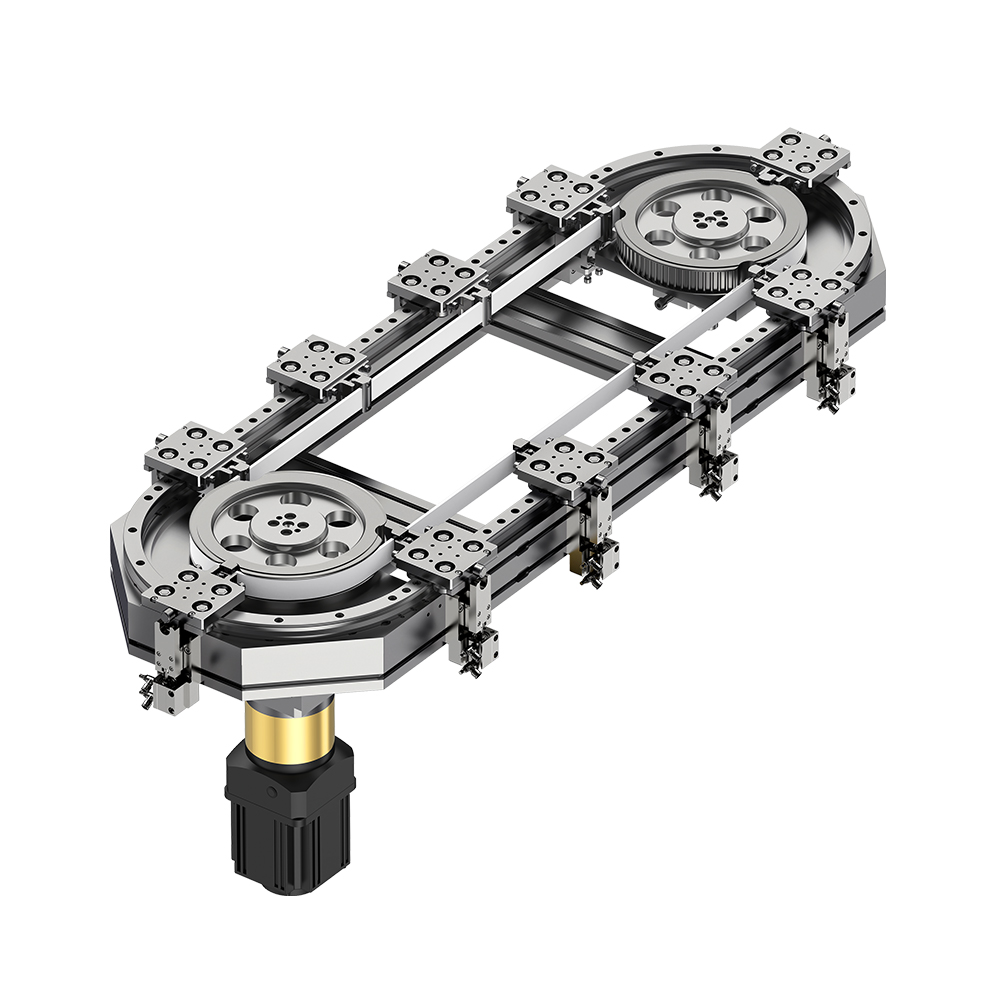
An oval conveyor track is a closed loop path assembled from three parts: a drive unit, a precision circular guide rail, and the carrier or pallet interface that carries the work product around the loop. The belt or chain mechanism runs inside the rail, the carriers ride the rail, and the drive indexes the loop from one stop position to the next.
The track is only the loop hardware. A complete oval conveyor system adds the drive package, the controls that handshake with your line controller, and the tooling mounted on the carriers — which is why two suppliers quoting the same loop footprint can land very different delivered costs.
Answer these five questions in order. The first answer that comes back "confirm with engineering" tells you where the project needs a drawing review before stations are designed around the loop.
Add up every carrier in motion at once, not just the heaviest one.
The T Series oval belt loop is published at 40 kg cumulative load — that is the whole loop, not per carrier. Above that, raise it with engineering before laying out stations.
Decide whether the work must pause at defined positions or flow without stopping.
The T Series uses a link type indexing chain conveyor mechanism for smooth indexed motion, described as reducing backlash and improving positioning stability.
Compare this against what your process window actually tolerates.
0.05 mm is the published repeat positioning accuracy of the T Series oval belt loop, with no secondary positioning required.
A loop that carries its own positioning usually replaces separate positioning hardware.
The T Series is described as a compact footprint that combines conveying and positioning, reducing system complexity while keeping operation stable.
Tooling, sensing and controls all mount on or around the loop.
The page states the system is compatible with various tooling setups and can integrate with sensors or vision systems.
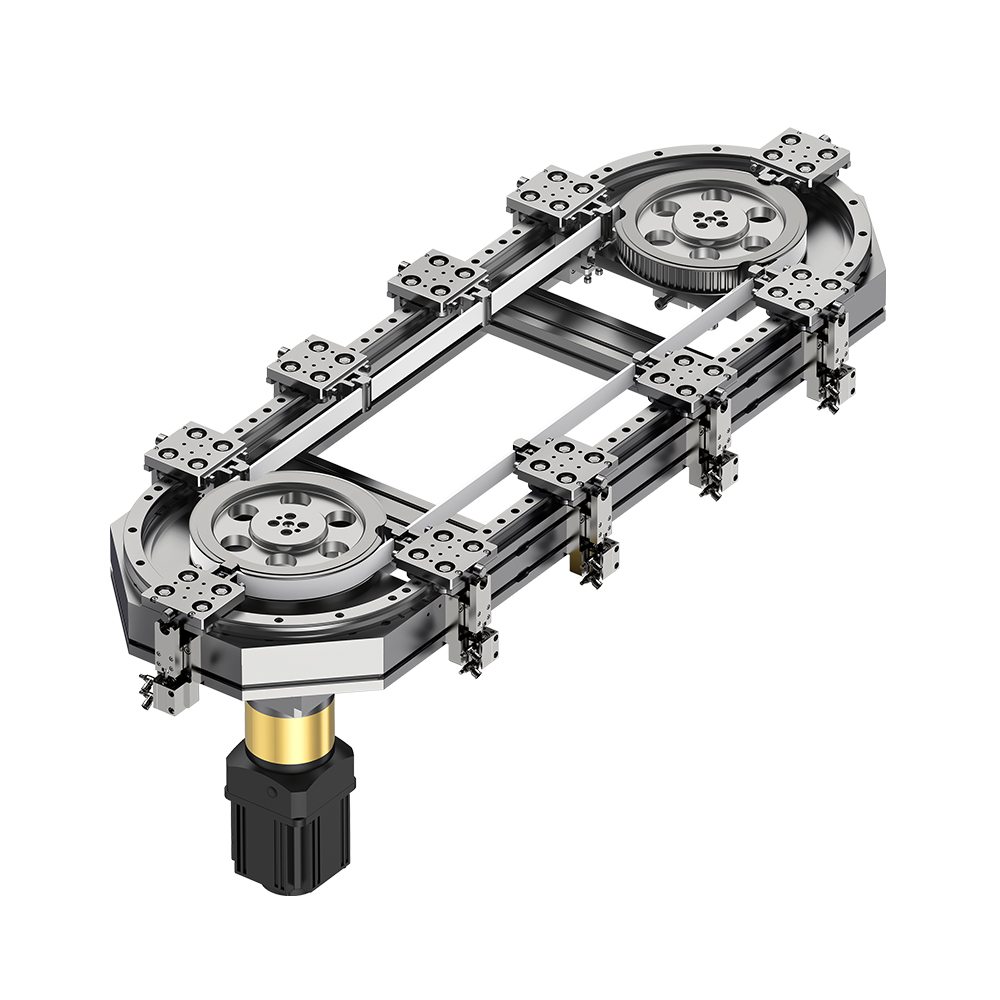
This is the loop to price first when your line needs positioning done by the conveyor itself rather than by a downstream station. The published build description is short and specific, which makes it easy to check against your own requirement list.
Reading a loop quote line by line is easier when you separate the structure from the motion and the interface. These are the five layers described on the product page, in the order the work product travels through them.

Three published figures decide more of your line layout than any other line on the datasheet. Read them as design margins, not as specification line items.

Repeatability decides whether you need a positioning station at all. Speed decides your cycle time ceiling. Load decides how many carriers you can run at once. Everything else on the data sheet is secondary to these three decisions — and all three are published for this loop.
Published with no secondary positioning required — the loop itself resolves the stop position.
The published ceiling for the loop, with conveying and positioning functions integrated in the same motion.
Stated as cumulative load, supported by the high-strength frame, good rigidity and strong load-bearing structure.
Caution when reading across series: these three figures are published for the T Series Oval Belt Conveyor System. Do not assume the same values apply to the elliptical, chain link or rectangular loops without written confirmation.
A loop stops being a conveyor and starts being a station when sensing and control are added. The product page states compatibility with various tooling setups and integration with sensors or vision systems — which is the point where the mechanical layout and the electrical design have to agree.

The product page names the application areas this loop is built for. Each one turns into a different specification conversation — here is how to frame it before you request a quote.
Small, light work products moving through several fine-alignment stations where the stop position has to be dependable on every cycle.
Component quality assurance and product reliability evaluation, where sensing hardware has to be positioned around the loop.
Sorting stations and line layouts where throughput and floor space compete, and the loop has to carry cumulative product weight.

Assembly lines carry accuracy risk, test rigs carry integration risk, and sorting lines carry throughput and space risk. The same oval belt loop answers all three, but each application puts a different figure first — which is why the specification conversation should start with the station, not with the loop dimensions.
The system is described as customizable, with the team working closely with clients to specify parameters and finalize plans. Sending these eight items in your first message shortens the round trip considerably.
Send the eight items above and reference the T Series Oval Belt Conveyor System. If the parameters fall outside the published 0.05 mm, 1000 mm/s and 40 kg envelope, say so in the same message — that is where a customizable, modular loop is planned rather than ordered from a catalogue.
Keep adjacent product options together for a faster catalog comparison.
0.05mm repeat positioning accuracy with 1000mm/s speed. The T Series integrates high-strength, modular design for reliable, cost-effective precision conveyor systems.
View product
Ensure stable automation with the KS series precision link conveyor. Featuring 1000mm/s speed and 40kg capacity, this robust conveyor link optimizes assembly.
View product
Featuring a rigid architecture, this indexing conveyor system delivers 0.05mm repeat accuracy at 1000mm/s for high-precision, automated industrial assembly.
View productrepeat positioning accuracy reaches 0.05 mm, with no secondary positioning required. that figure is published for the t series oval belt configuration specifically.
the maximum operating speed is 1000 mm/s and the cumulative load capacity is up to 40 kg. cumulative means the total across the loop, including carriers and tooling, not the weight of a single part.
the track is the loop hardware: drive unit, precision circular guide rail and carrier interface. a complete oval conveyor system adds the drive package, the controls and the tooling mounted on the carriers — so the loop dimension alone does not describe the delivered scope.
yes. the modular design allows rapid configuration, and the team works closely with clients to specify parameters and finalize plans. customization is a specification exercise, so the more parameters you send upfront, the faster the plan converges.
installation is described as straightforward because of the modular structure, and the system is designed for maintenance-free operation. modular design also facilitates rapid configuration changes while keeping that maintenance-free intent.
use the contact us page or the quote link shown with the product details, and include your loop geometry, cumulative load, stop count, required accuracy, tooling and controls interface. you can also reach the team by phone at +86 18102947625.