Electric linear actuators have become an important component in modern industrial automation. From automated assembly lines and packaging equipment to precision inspection systems and robotic handling machines, these devices provide controlled linear movement for a wide range of applications.
Compared with conventional pneumatic or hydraulic actuation systems, electric linear actuators offer advantages in programmable positioning, motion control, system integration, and application flexibility. They can be configured to meet different requirements for stroke, speed, thrust, and positioning performance.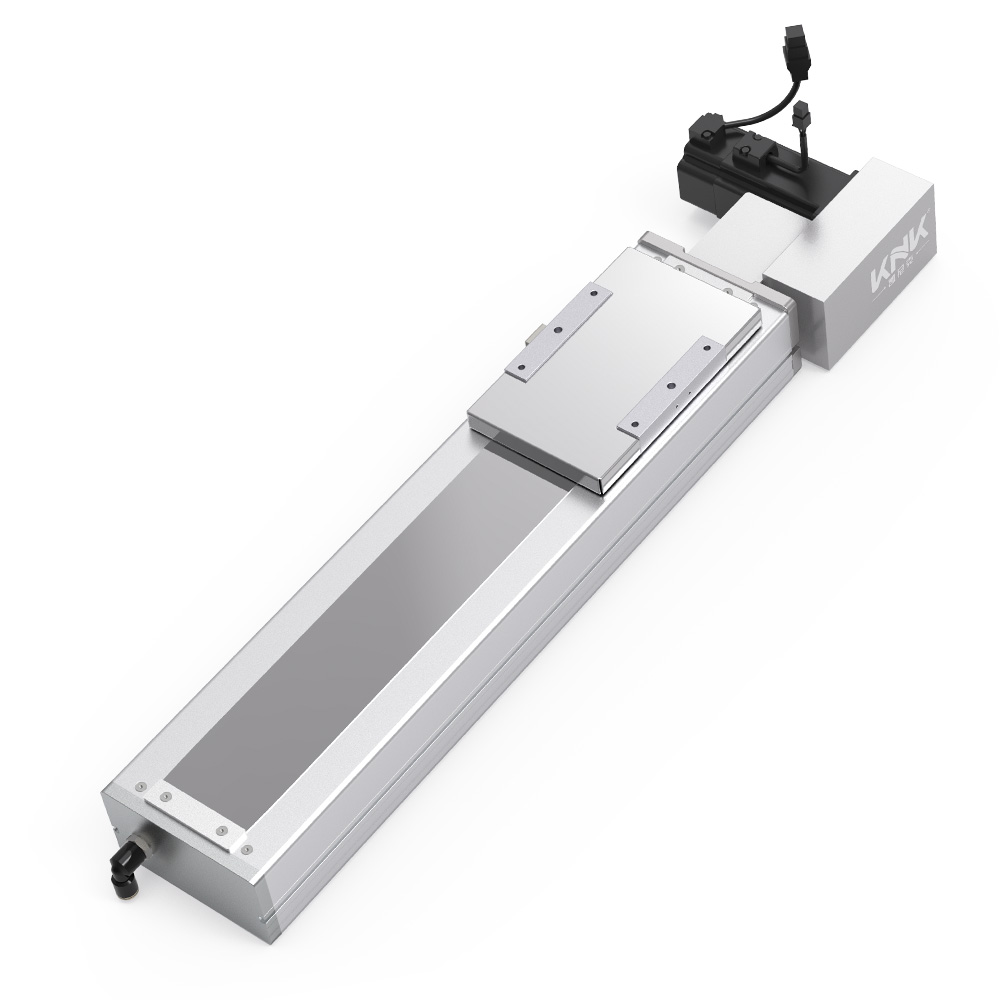
For OEM equipment manufacturers and automation system integrators, understanding why to use electric linear actuators is essential when designing reliable, efficient, and flexible machinery.
An electric linear actuator is a motion device that converts electrical energy into linear movement. It typically uses an electric motor combined with a mechanical transmission system to move a rod, carriage, or other connected component along a straight path.
Depending on the design, an electric linear actuator may use a ball screw, lead screw, timing belt, rack-and-pinion mechanism, or direct-drive technology.
Common configurations include electric cylinders, motorized linear modules, and integrated linear positioning systems.
The appropriate actuator depends on the application's required stroke, load, speed, duty cycle, accuracy, installation space, and control method.
One of the main reasons to use electric linear actuators is their ability to support controlled positioning. When paired with a suitable motor, controller, and feedback system, an electric actuator can move a component to programmed positions and repeat a defined motion sequence.
This is particularly useful in applications where components must be positioned consistently for assembly, inspection, dispensing, or material handling.
Positioning performance depends on the complete system, including the transmission mechanism, mechanical rigidity, encoder, control settings, load, and operating conditions. Selecting the correct actuator configuration is therefore essential.
Electric linear actuators can be integrated with PLCs, motion controllers, and servo systems to control position, speed, acceleration, and deceleration.
Different motion profiles can be programmed for different stages of a machine cycle. For example, an actuator may move quickly through most of its stroke and slow down near the final positioning point.
This flexibility helps equipment manufacturers develop machines that support multiple products, adjustable working positions, and changing production requirements.
Electric linear actuators are available in different sizes and configurations. For custom automation equipment, stroke length, mounting interfaces, motor orientation, and mechanical structure can often be selected to match the machine layout.
Depending on the application, engineers may choose:
Ball screw actuators for applications requiring high stiffness and controlled positioning.
Belt-driven linear actuators for longer travel and higher-speed movement.
Rack-and-pinion linear modules for applications requiring long travel and suitable load capacity.
Linear motor systems for direct-drive applications requiring high dynamic performance.
This range of configurations makes electric linear actuators suitable for both compact machinery and larger automated production systems.
Electric linear actuators can work with sensors, PLCs, servo drives, industrial networks, and other automation components.
A properly configured system can coordinate multiple axes, synchronize motion with conveyors, and exchange position or status information with the machine controller.
For example, a multi-axis pick-and-place machine may use electric actuators to move products between feeding, processing, and inspection stations.
The communication protocols and integration requirements should be confirmed before selecting the actuator and controller.
Electric linear actuators can eliminate the need for compressed air or hydraulic power at the point of actuation, depending on the machine design. This may reduce certain utility requirements and simplify system architecture.
Electric systems can also control motion only when required and adjust acceleration or speed according to the process. Regenerative capabilities may be available in some servo systems.
However, total energy consumption depends on the load, duty cycle, motor and drive efficiency, holding requirements, and standby power. Electric actuation is not automatically more energy-efficient in every application, so system-level evaluation is recommended.
Some industrial processes require an actuator to move between several positions rather than simply extend and retract.
Electric linear actuators can be programmed for intermediate positions, variable travel distances, and repeatable sequences when the drive and feedback system support these functions.
Typical examples include:
Moving workpieces between several assembly stations.
Adjusting the position of a fixture for different product sizes.
Changing the height of a machine platform.
Positioning a camera or sensor for inspection.
Feeding components at controlled intervals.
This flexibility is valuable for equipment manufacturers developing customized machinery or production systems that handle multiple product models.
Electric, pneumatic, and hydraulic actuators each have advantages. The right choice depends on the application rather than one technology being universally superior.
|
Feature |
Electric Linear Actuator |
Pneumatic Actuator |
Hydraulic Actuator |
|---|---|---|---|
|
Position control |
Well suited to programmable positioning with appropriate controls |
Often suited to end-position or simple motion; finer control requires additional equipment |
Can provide controlled positioning with suitable valves and feedback |
|
Motion profiles |
Flexible electronic control |
Usually simpler control architecture |
Depends on hydraulic circuit and control system |
|
Power source |
Electrical power |
Compressed air |
Hydraulic power unit |
|
High-force applications |
Available, depending on design |
Suitable for some moderate-force applications |
Often preferred for very high force and power density |
|
Multiple programmed positions |
Convenient with compatible controls |
May require additional valves and sensors |
Possible with suitable hydraulic controls |
|
Maintenance considerations |
Mechanical wear, lubrication, motor and drive condition |
Air leaks, seals, air quality |
Fluid condition, leaks, seals, and filtration |
|
Typical applications |
Precision positioning, assembly, inspection, automated handling |
Clamping, simple pick-and-place, rapid repetitive movements |
Heavy-duty pressing, lifting, and high-force machinery |
Electric linear actuators are often attractive when programmable positioning and integration with digital control systems are important. Pneumatic actuators may be simpler for basic two-position movements, while hydraulic systems may be more suitable for applications requiring very high force.
Automated Assembly
Electric actuators position components for fastening, insertion, alignment, and other assembly operations. Programmable motion can help equipment handle different product configurations.
Pick-and-Place Equipment
Linear actuators move grippers and handling tools between feeding, processing, and unloading positions. Multi-axis configurations can support more complex transfer paths.
Inspection and Measurement
Electric actuators position cameras, sensors, and workpieces for automated inspection. The required repeatability and stability depend on the measurement process and system design.
Packaging and Material Handling
Actuators can control product feeding, pushing, lifting, sorting, and transfer operations. Stroke and cycle time should be matched to the required production rate.
Multi-Axis Automation Systems
Electric linear actuators can be combined into X, Y, and Z axes for dispensing, laser processing, loading, unloading, and automated positioning.
Choosing an actuator based only on stroke length or motor power may lead to performance problems. Engineers should evaluate the complete operating conditions.
Calculate the moving mass and required force, taking acceleration, friction, mounting orientation, and external loads into account. Vertical applications may also require braking or a suitable load-holding mechanism.
A ball screw actuator may be suitable for controlled positioning and relatively high thrust. A belt-driven linear module can be useful for longer strokes and higher-speed travel. Other mechanisms may be preferable depending on travel length, rigidity, maintenance, and operating conditions.
Consider the required travel distance, acceleration, deceleration, dwell time, and total cycle time. Maximum speed alone does not determine how quickly the machine can complete its operating sequence.
Distinguish between absolute accuracy and repeatability. If the machine must return to the same position consistently, consider the transmission mechanism, encoder resolution, backlash, structural rigidity, and control strategy.
Confirm mounting dimensions, available space, motor orientation, cable routing, environmental conditions, and compatibility with the PLC or motion controller.
For OEM projects, providing these details to the actuator manufacturer early can help narrow down suitable configurations and avoid unnecessary redesign.
Many automation machines require more than a standard off-the-shelf actuator. A custom solution may be needed to accommodate limited installation space, a non-standard stroke, a specific mounting interface, a special motor arrangement, or coordination with other motion axes.
Custom electric linear actuator solutions may include:
Customized stroke length and overall dimensions.
Ball screw or belt-driven configurations selected for the application.
Motor and drive combinations matched to the required motion profile.
Special mounting interfaces for machine integration.
Single-axis or multi-axis arrangements.
Integration with sensors, controllers, and other automation equipment.
For OEM equipment manufacturers, the objective is to select a motion solution that meets the complete machine requirements while maintaining practical installation, maintenance, and operating costs.
KNK Technology provides linear motion products for industrial automation, including linear modules and electric cylinder solutions. When selecting a custom actuator, equipment designers should confirm the required load, stroke, speed, positioning performance, and control interface with the supplier.
Learn more about KNK Technology's linear motion solutions at https://www.knkmotion.com/.
Yes. Electric linear actuators can support precision positioning when paired with a suitable transmission mechanism, motor, feedback device, and control system. The achievable accuracy and repeatability depend on the complete mechanical and electrical design.
In many applications, yes. Electric actuators can replace pneumatic cylinders when programmable positions, adjustable speed, or electronic control are beneficial. However, the required force, cycle time, environment, cost, and load-holding needs should be evaluated before changing technologies.
An electric cylinder is a type of electric linear actuator, typically designed with a cylinder-like housing and a translating rod. The broader term electric linear actuator also includes linear modules and other mechanisms that produce controlled linear movement.
Many manufacturers offer customization options such as stroke, mounting dimensions, drive type, motor selection, and integration interfaces. The available options depend on the product design and the application's requirements.