Modern automation systems often require more than simple product transportation. When products need to move through multiple workstations while maintaining controlled movement and repeatable positioning, a Precision Circular Guide Conveyor can provide a practical solution.
Unlike conventional straight conveyors, a circular or closed-loop conveyor system can continuously transport products, pallets, or fixtures through multiple processing stations. With an engineered guide structure and customized carriers, the conveyor can be integrated with assembly, inspection, testing, dispensing, and robotic automation.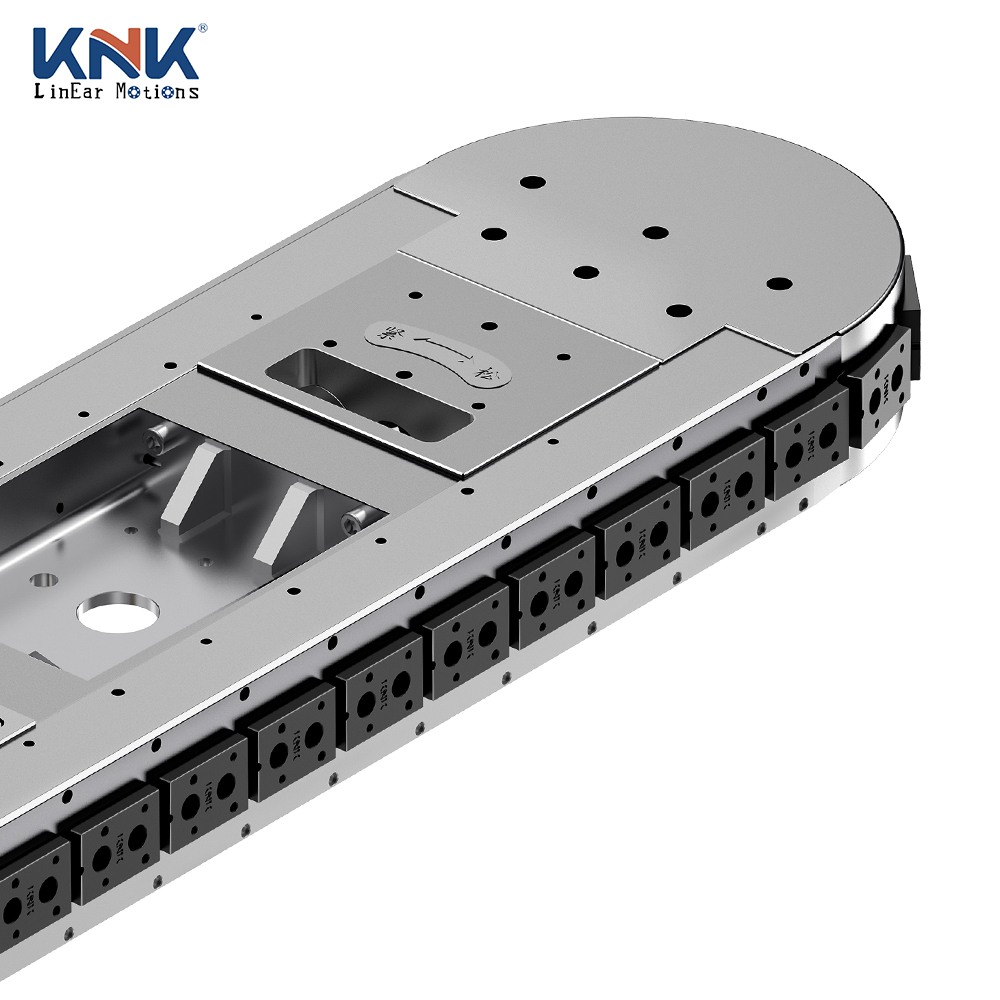
For OEM machine builders and automation integrators, a custom precision circular conveyor can be designed according to the required track layout, carrier dimensions, payload, speed, pitch, positioning requirements, and machine installation space.
A Precision Circular Guide Conveyor is a guided conveyor system designed to move products or carriers along a circular, oval, or closed-loop path.
A typical system can include:
The guide structure controls the movement of the carriers as they travel through straight or curved sections.
Depending on the production process, the conveyor can operate continuously or coordinate controlled stops at individual workstations.
The basic operating principle is relatively simple.
A motor drives the conveyor mechanism, which moves the carriers along the predefined guide path.
The basic process can be described as:
Drive System → Conveyor Movement → Guided Carrier → Processing Station → Return
For a multi-station production line, the complete workflow may be:
Loading → Assembly → Inspection → Testing → Processing → Unloading → Return
The closed-loop configuration allows carriers to circulate continuously and return to the starting point.
A conventional conveyor is mainly designed to transport products from one location to another.
A precision circular guide conveyor is more suitable when the conveyor itself needs to become part of the automated production process.
It can provide:
This makes it useful for applications where transportation and automation need to work together.
The guide rail provides a defined path for each carrier.
This can help maintain stable movement when products travel around curves and through different sections of the conveyor.
For automated assembly and inspection, controlled carrier movement can help improve process consistency.
A single circular conveyor can connect several production stations.
For example:
Station 1 → Station 2 → Station 3 → Station 4 → Station 5
Possible operations include:
This can reduce the need for separate transfer systems between individual stations.
The circular configuration creates a continuous production path.
After completing the required operations, the carrier can return to the loading station.
This is useful for:
For precision automation, the carrier is an important part of the system.
A custom carrier can be designed around:
This allows the same conveyor platform to be adapted for different products and production processes.
One of the most important considerations for automation applications is positioning.
When a carrier arrives at an assembly or inspection station, the product may need to be located at a repeatable position.
The positioning performance of the complete system can be influenced by:
For applications requiring higher positioning performance, dedicated positioning devices can be integrated at critical processing stations.
This is particularly useful for automated assembly, inspection, and testing.
A precision circular conveyor can provide a continuous platform for automated assembly.
A typical process may include:
Product Loading → Component Placement → Assembly → Fastening → Inspection → Testing → Unloading
Robotic or automated equipment can be installed around the conveyor.
Possible equipment includes:
The conveyor transports the product while each workstation performs a specific operation.
Automated inspection often requires products to pass through multiple inspection stages.
A precision circular conveyor can connect several inspection stations.
For example:
Cameras and sensors can be positioned at predefined locations around the conveyor.
If the inspection process requires consistent product positioning, the carrier and positioning mechanism can be customized accordingly.
A circular conveyor can also be integrated with pick-and-place robots.
Robots positioned around the conveyor can:
The conveyor provides continuous product circulation, while the robot performs the specific operation required at each station.
Testing equipment often requires products to remain at a stable position during the test.
A customized circular guide conveyor can move products between:
Loading → Testing → Inspection → Sorting → Unloading
At the testing station, a positioning mechanism can hold the carrier while the test is performed.
This approach can be used for:
OEM customers often have unique machine layouts and product requirements.
A custom precision circular conveyor can be configured according to:
The guide rail is a critical part of a precision circular conveyor.
A suitable guide structure should provide stable carrier movement through both straight and curved sections.
Design considerations include:
For demanding applications, the guide structure should be designed together with the carrier and drive mechanism rather than treated as an independent component.
Different drive technologies can be considered depending on the application.
A chain-driven system can be suitable for applications requiring:
Belt-driven systems can be considered for applications requiring:
Servo control can provide flexible speed and positioning control for applications requiring synchronization with other automation equipment.
The correct configuration depends on the required payload, speed, accuracy, cycle time, and operating environment.
| Feature | Precision Circular Guide Conveyor | Conventional Conveyor |
|---|---|---|
| Layout | Circular / Closed Loop | Usually Straight |
| Carrier Guidance | Controlled | Application dependent |
| Multi-Station Processing | Excellent | Good |
| Custom Carriers | Yes | Possible |
| Closed-Loop Operation | Yes | Usually requires return path |
| Positioning Integration | Excellent | Application dependent |
| Automation Integration | High | Moderate to High |
| OEM Customization | High | Moderate |
A conventional conveyor is suitable for basic transportation. A precision circular guide conveyor is more appropriate when the conveyor must also support multi-station automation and controlled product positioning.
When selecting a precision circular conveyor manufacturer, OEM customers should consider several factors.
The supplier should understand:
The supplier should be able to evaluate:
Look for the ability to customize:
The conveyor may need to work with:
Before requesting a quotation, OEM customers should provide:
With these details, a manufacturer can select an appropriate guide, drive, carrier, and frame configuration.
Custom circular conveyor systems can be used in:
A Precision Circular Guide Conveyor provides a flexible platform for automated production processes that require controlled product circulation and multiple workstations.
By combining a guided track, customized carriers, drive system, and positioning mechanism, the conveyor can support applications including automated assembly, inspection, testing, pick and place, dispensing, and material handling.
For OEM customers, the system can be customized according to track dimensions, carrier size, payload, carrier pitch, speed, positioning requirements, drive technology, and machine layout.
The goal is not simply to move products around a circular path. A properly designed precision conveyor should become an integrated part of the production system, working together with robots, sensors, inspection equipment, and automated processing stations.
For specialized automation projects, choosing a manufacturer with custom mechanical and motion-control capabilities can help ensure that the precision circular guide conveyor matches the actual production requirements.