In modern industrial automation, linear motion systems need to balance speed, travel distance, payload, positioning performance, and installation requirements. For applications that require fast movement over relatively long strokes, a Belt Driven Linear Module can be an effective solution.
Unlike a ball screw linear module, a belt driven linear module uses a timing belt and pulley system to convert motor rotation into linear movement. This structure allows the module to achieve high travel speeds while maintaining a relatively simple mechanical design.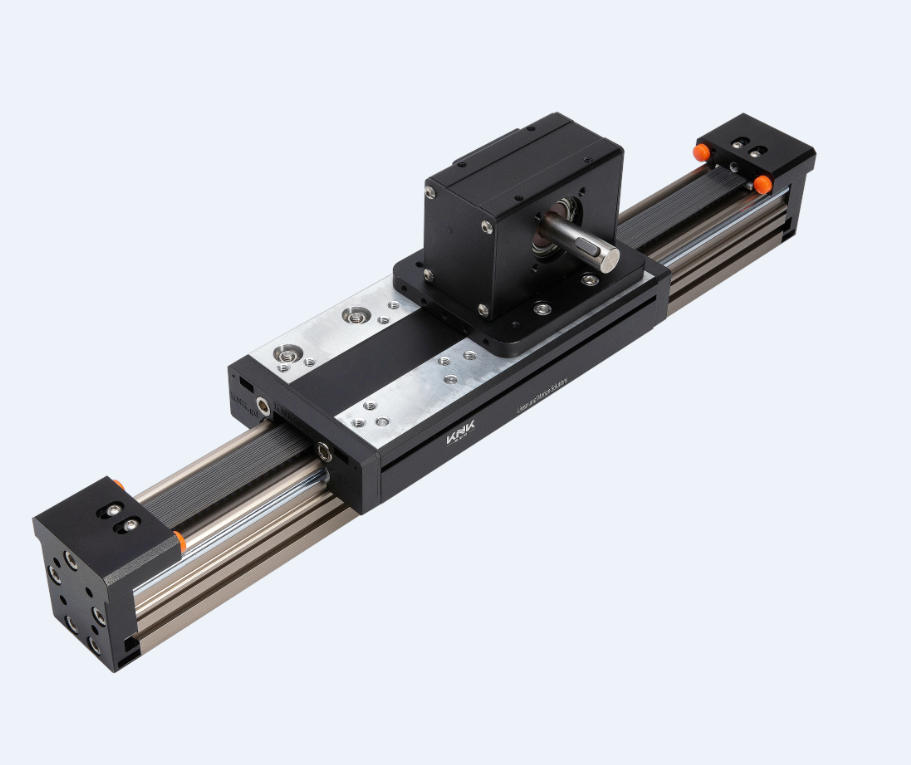
For OEM machine builders and automation integrators, the biggest advantage is flexibility. A custom belt driven linear module can be configured according to the application's required stroke, payload, speed, accuracy, motor, mounting method, and overall machine dimensions.
A Belt Driven Linear Module is a linear motion component that uses a motor-driven timing belt to move a carriage along a linear guide.
A typical module consists of:
When the motor rotates the drive pulley, the timing belt moves the carriage along the linear guide.
The basic motion process is:
Motor → Pulley → Timing Belt → Carriage → Linear Movement
The combination of belt drive and linear guide provides a compact solution for many automated positioning and transfer applications.
A belt drive is particularly useful when an automation application requires high speed and long travel.
Compared with some other linear drive technologies, a belt driven linear module can offer several advantages:
This makes belt driven linear modules common in applications such as:
Standard linear modules may not match the dimensions or performance requirements of a specialized machine.
A custom belt driven linear module can be designed around the actual application.
OEM customization may include:
The linear travel can be selected according to the required movement distance.
The module can be selected based on the combined weight of:
The belt drive can be configured for applications requiring rapid linear movement.
The required positioning performance should be evaluated according to the application.
Possible motor configurations include:
The module can be adapted for:
One of the most common questions from automation engineers is whether to use a belt driven or ball screw linear module.
| Feature | Belt Driven Linear Module | Ball Screw Linear Module |
|---|---|---|
| Drive Method | Timing belt | Ball screw |
| Speed | High | Moderate to high |
| Long Stroke | Excellent | More challenging at high speed |
| Positioning | Good | Generally higher precision potential |
| Acceleration | Suitable for high-speed applications | Application dependent |
| Maintenance | Relatively simple | Requires screw lubrication |
| Typical Applications | Transfer, pick and place | Precision positioning |
| Long Travel | Excellent | Application dependent |
The choice should not be based on price alone. Stroke, speed, payload, accuracy, cycle time, and operating environment should all be considered.
High-speed movement is one of the main reasons engineers select a belt driven linear axis.
For example, a pick-and-place system may need to:
Move → Stop → Pick → Move → Place → Return
When this cycle is repeated hundreds or thousands of times, reducing travel time can have a direct effect on production efficiency.
A properly selected belt driven linear module can provide fast acceleration and long-distance movement for applications where ultra-high positioning accuracy is not the primary requirement.
Long-stroke applications can be challenging for some mechanical drive systems.
A belt driven linear module can be suitable when the application requires extended travel.
Potential applications include:
The required stroke should be evaluated together with payload, speed, acceleration, and mounting orientation.
Pick-and-place automation is a common application for belt driven linear modules.
A typical system may combine:
X-Axis + Z-Axis + Gripper
The X-axis provides fast horizontal transfer, while the Z-axis performs vertical movement.
A multi-axis configuration can be used for:
The module can also be integrated with sensors and motion controllers for automated positioning.
Multiple belt driven linear modules can be combined to create a Cartesian robot.
For example:
X + Y + Z = 3-Axis Cartesian Robot
The X-axis can provide long horizontal travel, while the Y-axis and Z-axis provide cross-axis and vertical movement.
This configuration can be customized for:
For larger working areas, the linear modules can be integrated into a gantry structure.
A belt driven linear module can also serve as the motion axis of a linear gantry system.
A typical gantry system may include:
For OEM applications, the axis length, payload, motor configuration, and mounting structure can be customized according to the machine layout.
Selecting the correct module requires more than simply checking maximum speed.
The total moving mass affects acceleration, motor selection, guide loading, and belt tension.
Longer travel requires consideration of belt length, profile rigidity, and guide performance.
The required operating speed should be considered together with acceleration and cycle time.
Frequent starts and stops place additional demands on the belt and drive system.
Horizontal and vertical applications can have significantly different load requirements.
A module operating continuously throughout a production shift may require a different configuration from one used intermittently.
A belt driven linear module is generally selected for speed and long travel, but positioning performance can still be optimized.
Important factors include:
For applications requiring higher positioning accuracy, engineers should evaluate the entire motion system rather than focusing only on the belt.
If the application requires extremely high positioning accuracy, a ball screw or linear motor module may be more appropriate depending on the operating conditions.
A customized system can be configured according to the machine's requirements.
Depending on the working environment, additional protection may be required against:
For complex automation equipment, several linear modules can work together.
A typical system might use:
Belt Driven X-Axis + Belt Driven Y-Axis + Electric Z-Axis
This combination can balance speed and vertical load requirements.
For example, the X and Y axes can provide fast horizontal movement, while a screw-driven or electric cylinder Z-axis can provide controlled vertical positioning.
This type of hybrid architecture can be useful for customized automation machines.
When selecting a linear module manufacturer, OEM customers should evaluate the supplier's engineering capabilities as well as the product itself.
Important factors include:
The supplier should be able to evaluate:
The manufacturer should be able to customize:
For OEM customers, technical support can be important during:
A manufacturer with both linear motion products and application engineering capabilities can simplify the development process.
Before requesting a quotation, provide as much of the following information as possible:
This information helps the manufacturer select an appropriate belt driven linear module instead of simply recommending a standard model.
Custom belt driven linear modules can be used in a wide range of industries.
A Belt Driven Linear Module is a practical linear motion solution for automation applications that require high speed, long travel, flexible installation, and reliable repetitive movement.
For OEM machine builders and automation integrators, customization can cover stroke, payload, speed, accuracy, motor, carriage, sensors, mounting configuration, and multi-axis integration.
The most suitable linear module depends on the actual application. Belt-driven systems are often a strong choice for high-speed and long-stroke movement, while ball screw or linear motor systems may be more appropriate when the application places greater emphasis on precision or other specific performance requirements.
By working with an experienced custom linear module manufacturer, OEM customers can develop a motion system around their machine's actual requirements instead of adapting the machine to a fixed standard module.