Modern automation equipment often requires more than a standard linear motion component. Different machines have different requirements for stroke length, payload, speed, positioning accuracy, installation dimensions, and operating environment. When an off-the-shelf linear module cannot meet these requirements, a Linear Screw Module Customized solution can provide a more suitable option.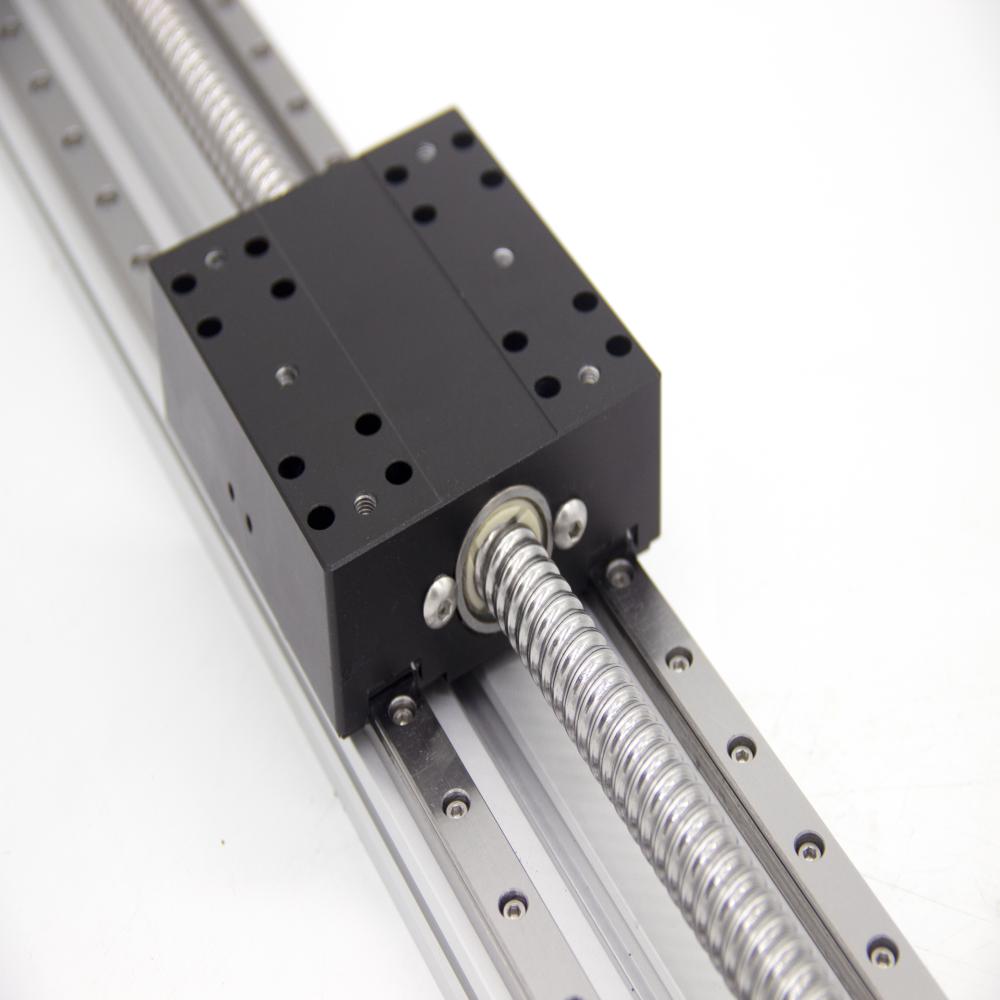
A customized linear screw module combines a precision screw drive with a linear guide mechanism to achieve controlled and repeatable linear movement. It can be engineered according to the mechanical and motion requirements of a specific machine.
For OEM manufacturers, automation integrators, and equipment designers, custom linear screw modules provide greater flexibility when developing precision positioning equipment, assembly machines, inspection systems, and automated production lines.
A linear screw module is a linear motion unit that converts the rotational motion of a motor into controlled linear movement through a screw mechanism.
Depending on the required performance, the module can use a ball screw or other screw-drive configurations.
A typical linear screw module consists of:
The motor rotates the screw, causing the carriage to move along the linear guide.
This structure provides controlled movement and is particularly suitable for applications where precision and repeatability are more important than extremely high travel speed.
A standard linear module may work for general applications, but customized automation equipment often has more specific requirements.
A Linear Screw Module Customized solution can be designed around the actual application instead of forcing the machine design to adapt to a standard product.
Common customization requirements include:
The travel distance can be selected according to the machine's working range.
Typical requirements may include:
The screw length and module structure can be optimized accordingly.
Different applications may require the carriage to move:
The screw, guide rail, carriage, and motor should therefore be selected according to the actual payload and moment loads.
Screw-driven modules are often selected for applications requiring controlled and precise movement.
The required speed depends on factors such as:
For applications requiring both high speed and precision, engineers need to balance these parameters during the design stage.
Accuracy is one of the main reasons engineers choose screw-driven linear modules.
A customized system can be designed around requirements for:
However, the actual achievable accuracy depends on the screw specification, guide system, machining tolerances, assembly quality, motor, controller, load, and operating conditions.
For this reason, an experienced manufacturer should evaluate the complete motion system rather than selecting a module based only on the screw type.
A major consideration when developing a customized linear screw module is the selection of the screw mechanism.
| Feature | Ball Screw | Lead Screw |
|---|---|---|
| Precision | High | Moderate to High |
| Efficiency | High | Lower |
| Friction | Low | Higher |
| High-Speed Operation | Suitable | Application dependent |
| Backlash Control | Excellent with proper configuration | Depends on design |
| Typical Applications | Precision automation | General positioning |
| Cost | Higher | Lower |
For demanding applications involving precision positioning, high repeatability, or continuous operation, ball screw solutions are often considered.
For simpler positioning applications, lead screw configurations can provide a more economical solution.
The working principle is relatively straightforward:
Motor Rotation → Screw Rotation → Linear Carriage Movement → Precise Positioning
During operation:
With a servo motor and suitable control system, the module can achieve controlled acceleration, deceleration, and positioning.
A custom linear screw module can be used in many industrial automation applications.
Suitable for:
The module provides controlled movement for assembly tooling and workpieces.
A screw-driven linear module can move cameras or products to predetermined inspection positions.
Applications include:
When integrated with a gripper or robotic system, the module can provide accurate linear movement for:
Custom linear screw modules can move dispensing heads along programmed paths.
Typical applications include:
The modules can also be used for:
For OEM projects, a manufacturer can customize multiple parameters.
Configured according to required travel distance.
Selected according to static and dynamic loading conditions.
Ball screw or lead screw depending on performance requirements.
Possible configurations include:
Selected according to load, speed, rigidity, and installation requirements.
Customized mounting holes, brackets, and installation interfaces can simplify integration into existing equipment.
Limit switches, home sensors, and other position-detection components can be integrated.
Multiple linear screw modules can be combined to create:
OEM customers often need a motion module that fits directly into their machine instead of a generic product.
A customized solution can be designed according to the complete machine architecture.
For example:
Linear Screw Module + Servo Motor + Controller + Fixture + Sensor
can form a complete positioning unit.
Multiple modules can then be integrated into an automated system for:
This approach allows the motion system to be optimized around the customer's actual machine rather than adapted afterward.
Before contacting a manufacturer, engineers should prepare several key parameters.
How far does the carriage need to travel?
What is the total moving load?
What is the required maximum and average operating speed?
How precisely does the carriage need to reach the target position?
How frequently will the module operate?
Will it be installed horizontally, vertically, or at an angle?
Consider:
Providing these details helps the manufacturer select the appropriate screw, guide, motor, and structural configuration.
Choosing a supplier capable of customization can simplify the development process.
A professional manufacturer should be able to provide:
For OEM customers, this engineering support is often more valuable than simply purchasing an individual linear module.
The choice between a screw-driven module and a belt-driven module depends on the application.
| Feature | Linear Screw Module | Belt Driven Linear Module |
|---|---|---|
| Precision | Generally higher | Generally lower |
| High-Speed Travel | Application dependent | Excellent |
| Long Stroke | Suitable depending on design | Excellent |
| Positioning | Excellent | Good |
| Rigidity | High | Moderate |
| Typical Application | Precision positioning | High-speed transfer |
If the application prioritizes precision, repeatability, and controlled positioning, a screw-driven solution may be more appropriate.
If the application prioritizes long travel and high-speed movement, a belt-driven linear module may offer advantages.
The best choice should be based on the complete set of motion requirements rather than price alone.