A variable pitch system is a motion solution designed to change the spacing between multiple products, carriers, tooling positions, or sliders during an automated process. Unlike a conventional linear motion system with fixed spacing, a variable pitch system allows the relative distance between moving elements to be adjusted according to production requirements.
This capability is valuable when products enter a machine at one spacing but need to be processed, inspected, assembled, or packaged at another spacing.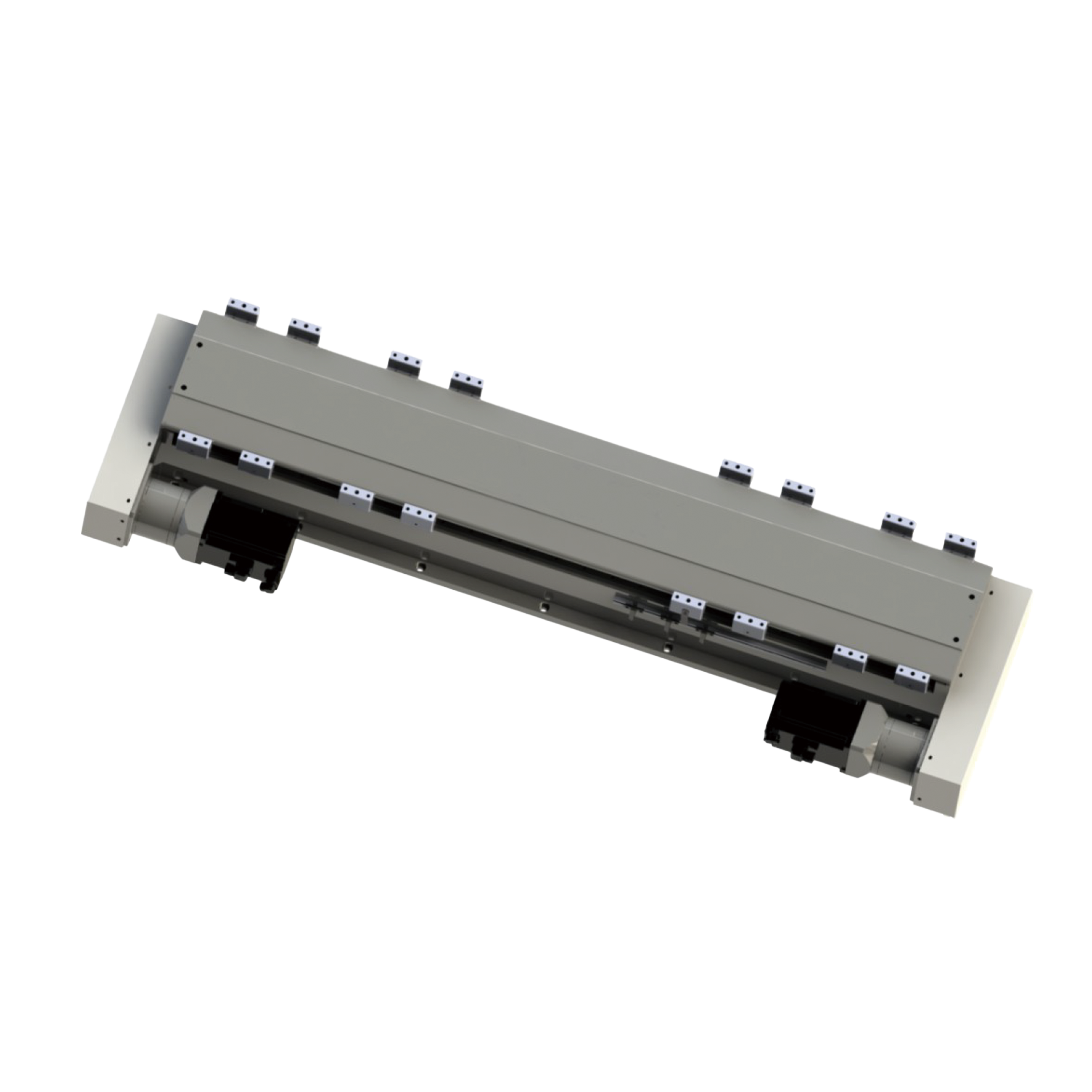
For OEM equipment manufacturers and automation integrators, a custom variable pitch system can be designed around the required pitch range, number of moving elements, payload, speed, stroke, accuracy, and machine layout.
A variable pitch system is a mechanical and motion-control solution that allows multiple moving elements to change their relative spacing.
For example, four products may enter an automation process with a small pitch. Before the next operation, the system can increase the spacing between the four products so that they match the tooling or downstream production stations.
A typical variable pitch system may include:
The exact configuration depends on the application and required motion sequence.
The system can be used as an independent positioning mechanism or integrated with conveyors, pick-and-place systems, assembly machines, inspection equipment, and other automated production systems.
The primary function of a variable pitch system is to adjust the distance between multiple moving elements.
Depending on the machine design, it can be used to:
This makes variable pitch technology particularly useful when different machines or processes operate at different product spacing.
A variable pitch system can use multiple sliders that move together while maintaining controlled relative positions.
This allows several products or tools to be processed simultaneously.
For example, a four-slider system could pick up four components at the same time and then adjust their spacing before transferring them to another production station.
The number of sliders, pitch range, and movement profile can be customized according to the application.
Servo motors can be used when the application requires programmable pitch adjustment and controlled positioning.
A servo-driven system can coordinate:
This allows the pitch to be changed according to different product types or production recipes.
For machines handling multiple product specifications, programmable pitch adjustment can provide additional production flexibility.
In high-volume automation, changing product spacing needs to be completed within a short cycle time.
A suitable variable pitch system can perform rapid spacing adjustment between different processing stages.
This is useful for:
The achievable speed and cycle time depend on the system's mechanical design, moving mass, motor, guide, pitch range, and control system.
Different applications require different minimum and maximum pitch values.
A custom variable pitch system can be designed according to:
This is one of the main reasons variable pitch systems are useful for custom OEM machinery.
A variable pitch system can help one automation machine process products with different spacing requirements.
For example, an assembly machine may receive products from a conveyor at a fixed pitch but require a different spacing for the assembly tooling.
Instead of adding multiple independent positioning mechanisms, a variable pitch system can perform the spacing conversion as part of the automated process.
A well-designed variable pitch mechanism can combine multiple spacing functions within one motion assembly.
This can reduce the need for separate actuators for every individual product position.
For compact automation equipment, the system can be customized according to:
The difference between the two systems is mainly related to product spacing.
| Feature | Fixed Pitch System | Variable Pitch System |
|---|---|---|
| Fixed spacing | Yes | Possible |
| Adjustable spacing | Limited | Yes |
| Multi-product handling | Yes | Yes |
| Pitch conversion | Requires additional mechanism | Main function |
| Synchronized motion | Possible | Common |
| Programmable pitch | Limited | Suitable |
| Custom pitch range | Limited | Highly configurable |
| OEM applications | Suitable | Particularly suitable |
A fixed-pitch system can be appropriate when products always enter and exit at the same spacing.
A variable pitch system becomes more valuable when product spacing needs to change during the production process.
Pick-and-place equipment is one of the most common applications for adjustable pitch motion.
Products may arrive at one spacing on a conveyor but need to be placed into:
A variable pitch system can adjust the spacing between multiple grippers or products before placement.
Packaging lines frequently require products to be grouped, separated, or positioned according to the package configuration.
A variable pitch system can be used for:
For example, products can be received at a continuous conveyor pitch and then adjusted to match the spacing of packaging cavities.
Electronic components are often handled in groups and may need different spacing at different production stages.
Variable pitch systems can be integrated into:
Multiple sliders can move components simultaneously while changing their relative spacing.
Inspection systems may require multiple products to be positioned at a specific distance from cameras or sensors.
A variable pitch system can adjust product spacing before inspection, allowing several products to be processed simultaneously.
Potential applications include:
Products entering a sorting system may have one spacing but need to be distributed into different positions.
A variable pitch mechanism can adjust spacing before products are transferred to another conveyor or processing station.
This can be useful for high-throughput material handling systems.
Different assembly stations may require different product spacing.
A variable pitch system can act as a pitch conversion mechanism between stations.
For example:
Input Conveyor → Variable Pitch System → Assembly Station → Inspection Station
The system can adjust the product spacing to match the requirements of the next process.
Precision manufacturing equipment may require multiple components to move simultaneously with controlled relative positioning.
Variable pitch technology can be considered for:
The guide, drive, encoder, and mechanical structure should be selected according to the required positioning performance.
For OEM customers, the required pitch configuration can vary significantly between machines.
A custom design can be developed according to:
Number of Sliders → Initial Pitch → Final Pitch → Pitch Range → Stroke → Payload → Speed → Accuracy → Cycle Time → Installation Space
For example, an automation machine may need eight products to enter at one pitch and leave at a larger pitch.
Another machine may require multiple tooling heads to move synchronously while changing their relative spacing according to different product specifications.
These applications are difficult to address with a fixed standard mechanism.
A custom variable pitch system allows the mechanical structure and motion profile to be designed around the customer's production process.
For OEM and custom automation applications, a variable pitch system can be customized in several areas:
This makes the system suitable for specialized automation equipment rather than only standard catalog machines.
Before selecting a variable pitch system, OEM engineers should define the following parameters:
These parameters allow the manufacturer to determine an appropriate mechanical structure and drive configuration.
A standard variable pitch mechanism may not match the exact requirements of an OEM machine.
Working with a custom manufacturer allows the system to be designed around the complete production process.
The manufacturer can evaluate:
Product → Pitch → Slider → Guide → Drive → Motor → Encoder → Control → Machine Interface
This integrated approach can be particularly useful for:
For OEM applications, the goal is to create a variable pitch system that fits the machine's actual requirements rather than adapting the machine around a fixed standard mechanism.