A precision link conveyor is a conveyor system designed to transport products, components, pallets, or workpieces through multiple processing stations with controlled movement and positioning.
Unlike a conventional belt conveyor that is mainly designed for continuous material transport, a precision link conveyor is often used when an automation system requires repeatable positioning, controlled indexing, multi-station processing, and integration with automated equipment.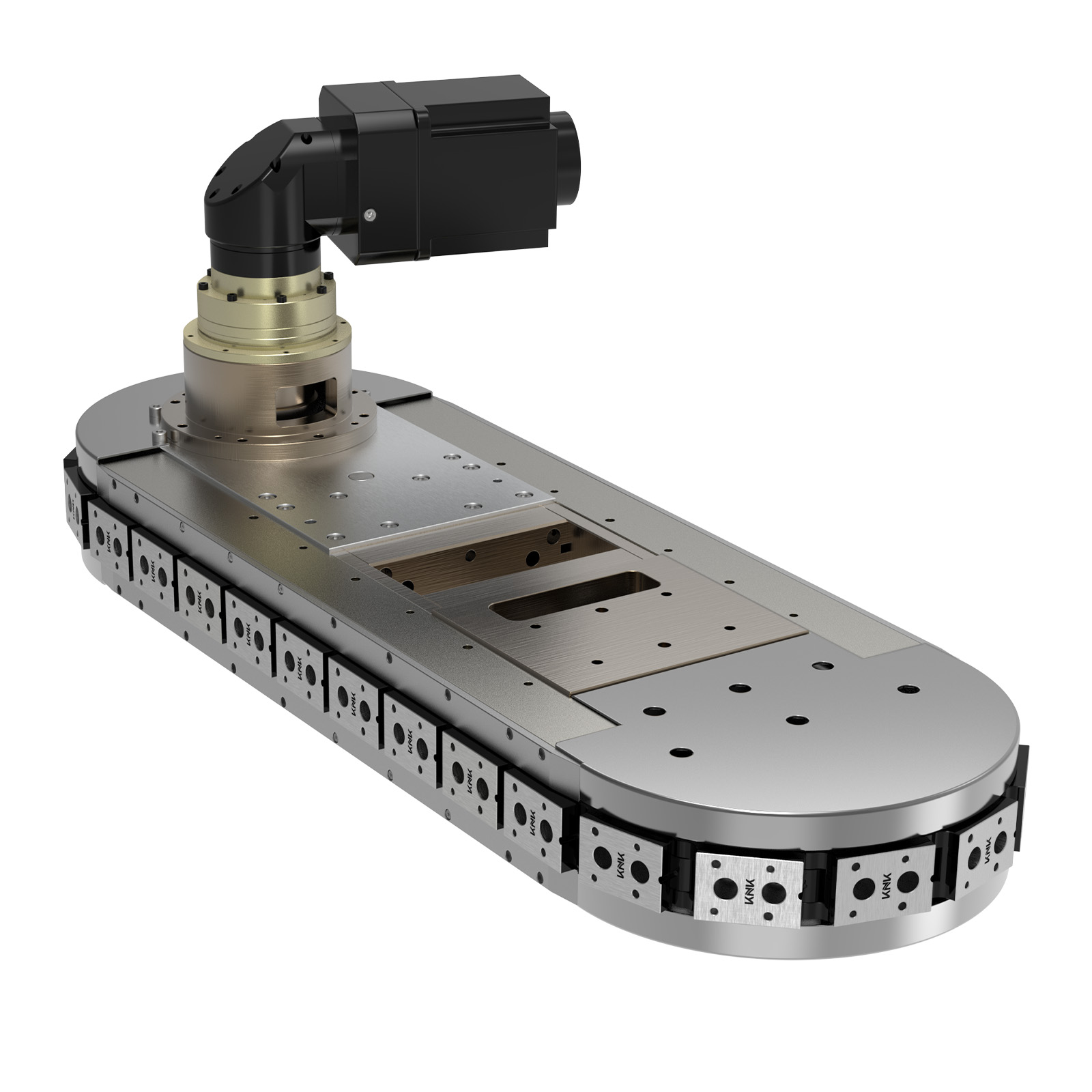
The conveyor can be configured according to the customer's product dimensions, production process, required travel distance, number of workstations, load requirements, and machine layout.
For OEM equipment manufacturers, this makes a precision link conveyor a practical solution when a standard conveyor cannot fully match the required production process.
One of the main advantages of a precision link conveyor is its ability to provide controlled movement and repeatable positioning.
This is particularly important when products need to stop at fixed processing stations for:
For applications where the product must repeatedly reach the same processing position, conveyor design, drive selection, workpiece fixtures, sensors, and positioning mechanisms can be coordinated as part of the complete system.
Precision link conveyors are well suited to production lines containing multiple workstations.
A typical production process may include:
Loading → Assembly → Inspection → Testing → Processing → Unloading
Products can move between different stations while automated equipment performs specific operations at each position.
This structure is useful for manufacturers developing automated production equipment because the conveyor becomes part of the overall machine rather than simply acting as a material transport device.
Different machines require different conveyor dimensions.
A custom precision link conveyor can be designed around the customer's available installation space and production requirements.
Depending on the application, important design parameters may include:
For long production lines or special machine layouts, a customized conveyor can provide more flexibility than an off-the-shelf conveyor.
For automation equipment, transporting the product alone is often not enough.
Workpieces may require dedicated carriers, pallets, tooling plates, or fixtures to maintain their orientation during transportation and processing.
A precision link conveyor can therefore be designed together with customized workpiece carriers.
This approach is useful when:
The conveyor and fixture design can be matched to the customer's actual product.
A precision conveyor system needs to work together with the machine's control system.
Depending on the application, movement may be coordinated with:
The objective is not simply to move a product from point A to point B, but to synchronize transportation with the complete automation process.
OEM automation equipment often has different requirements from one project to another.
A precision link conveyor can be customized for different:
This flexibility makes it suitable for machine builders who need a conveyor system designed specifically around their equipment.
| Feature | Precision Link Conveyor | Conventional Belt Conveyor |
|---|---|---|
| Product transportation | Yes | Yes |
| Controlled indexing | Suitable | Application dependent |
| Repeatable positioning | High potential | Generally lower |
| Multi-station automation | Excellent | Good |
| Custom carriers | Suitable | Application dependent |
| Automated assembly | Excellent | Good |
| Custom machine integration | Excellent | Moderate |
| Continuous material transport | Yes | Excellent |
| OEM customization | High | Medium to high |
The right solution depends on the required accuracy, speed, payload, product characteristics, and automation process.
Precision link conveyors are commonly considered for automated assembly equipment where products need to pass through several processing stations.
For example:
Loading → Component Assembly → Fastening → Inspection → Functional Test → Unloading
Each station can perform a dedicated operation while the conveyor controls product movement between stations.
Electronic components and assemblies often require controlled transportation between assembly and inspection processes.
A precision link conveyor can be integrated with:
Custom carriers can also help maintain the position of individual components during automated processing.
Automotive components may require multiple automated operations during production.
A precision link conveyor can be incorporated into equipment for:
The conveyor configuration can be adapted to the dimensions and production sequence of the customer's component.
Packaging equipment often requires products to move through several synchronized processes.
A precision conveyor can be integrated with:
For applications requiring controlled product spacing and positioning, a precision link conveyor can provide a more structured transport solution.
Inspection systems often require products to arrive at a defined position before cameras, sensors, or testing equipment perform measurements.
Precision link conveyors can be used in:
The conveyor can be synchronized with inspection equipment to create an automated inspection sequence.
When combined with robotic arms or pick-and-place units, a precision link conveyor can transport workpieces between automated handling stations.
For example:
Conveyor → Positioning Station → Pick-and-Place Unit → Assembly Station → Inspection Station
This type of configuration is useful for automated production systems requiring repeated product handling.
Precision link conveyors can also be developed as part of specialized machinery where standard conveyor products are difficult to integrate.
Typical applications include:
For OEM customers, the conveyor should be selected based on the complete machine requirements rather than simply choosing a standard conveyor size.
A customized solution can consider:
The carrier and conveyor structure can be designed around the actual workpiece size.
The required payload should include the workpiece, fixture, carrier, and any additional tooling.
Conveyor movement should match the required production cycle and processing time at each station.
If automated processing requires repeatable positioning, the conveyor and positioning mechanism should be considered together.
Straight, closed-loop, multi-station, or other customized configurations can be considered according to the machine layout.
The conveyor should be compatible with the customer's PLC, sensors, motors, robots, vision systems, and other automation components.
Before contacting a conveyor manufacturer, OEM customers can prepare the following information:
Providing these parameters allows the manufacturer to evaluate the mechanical structure and recommend a suitable conveyor configuration.
A custom conveyor can be designed around the actual automation process instead of forcing the production line to adapt to a standard conveyor.
For machine builders and OEM customers, this can provide advantages such as:
For complex automation projects, the conveyor should be treated as an important part of the machine architecture rather than an independent material-handling component.