Linear motion manufacturers design and produce mechanical systems that convert motor power into controlled linear movement. These systems are widely used in industrial automation, robotics, machine tools, assembly equipment, inspection systems, and production lines.
A complete linear motion solution may include:
For OEM customers, selecting a manufacturer is not simply about purchasing a standard linear rail or actuator. The more important consideration is whether the manufacturer can provide a linear motion system designed around the actual application.
Factors such as stroke, payload, speed, acceleration, positioning accuracy, installation space, motor type, and operating environment can all influence the final design.
Different automation applications require different motion characteristics.
Professional linear motion manufacturers may provide several drive options, including:
Belt-driven systems are suitable for applications requiring relatively high speed and long travel.
Typical applications include:
Ball screw systems are commonly selected when higher positioning accuracy and controlled linear movement are required.
They can be used for:
Gear rack systems can be useful for applications requiring long travel distances and higher load capacity.
They can be configured for:
Linear motor technology eliminates traditional mechanical transmission components such as belts and screws.
It can provide high-speed and highly responsive motion for applications such as:
The appropriate drive technology should be selected according to the application's speed, load, stroke, accuracy, and duty cycle rather than simply choosing the most advanced technology.
Standard products do not always fit OEM equipment.
A custom linear motion system can be designed according to the available installation space and required travel.
Customization may include:
This is particularly important for machine builders developing specialized automation equipment.
Load and speed requirements can vary significantly between applications.
For example, a lightweight inspection system may prioritize fast movement, while a material handling system may require greater load capacity.
When selecting a linear motion system, engineers should consider:
Payload + carrier weight + external force + acceleration + duty cycle
The correct combination of guide, drive, motor, and structure helps achieve stable operation.
Actual performance should always be verified against the specific application conditions.
Many automated machines require repeatable positioning at specific locations.
Depending on the application, a linear motion system can incorporate:
The required positioning performance depends on the complete system, including the mechanical structure, guide system, motor, encoder, controller, load, and operating conditions.
For this reason, experienced linear motion manufacturers should evaluate the complete motion requirement rather than focusing on a single component specification.
Linear modules can be combined to create multi-axis systems.
Common configurations include:
For example, an XYZ system can provide independent movement in three directions for automated pick-and-place, dispensing, inspection, or assembly.
This modular approach allows OEM customers to build a motion platform around the required machine process.
Linear motion products can be integrated with many industrial control systems.
Typical components include:
This makes linear motion systems suitable for both standalone equipment and complete automated production lines.
| Linear Motion Product | Typical Advantages | Common Applications |
|---|---|---|
| Belt Linear Module | High speed, long travel | Transfer, pick & place |
| Ball Screw Module | Precision positioning | Assembly, inspection |
| Gear Rack Module | Long travel, high load | Robot transfer, large machines |
| Linear Motor Module | High speed, responsiveness | Semiconductor, inspection |
| Electric Cylinder | Compact powered linear motion | Automation, pressing, lifting |
| Linear Guide | Smooth guided movement | Machinery, automation |
| XYZ Linear System | Multi-axis movement | Robotics, dispensing, assembly |
The best configuration depends on the machine's technical requirements.
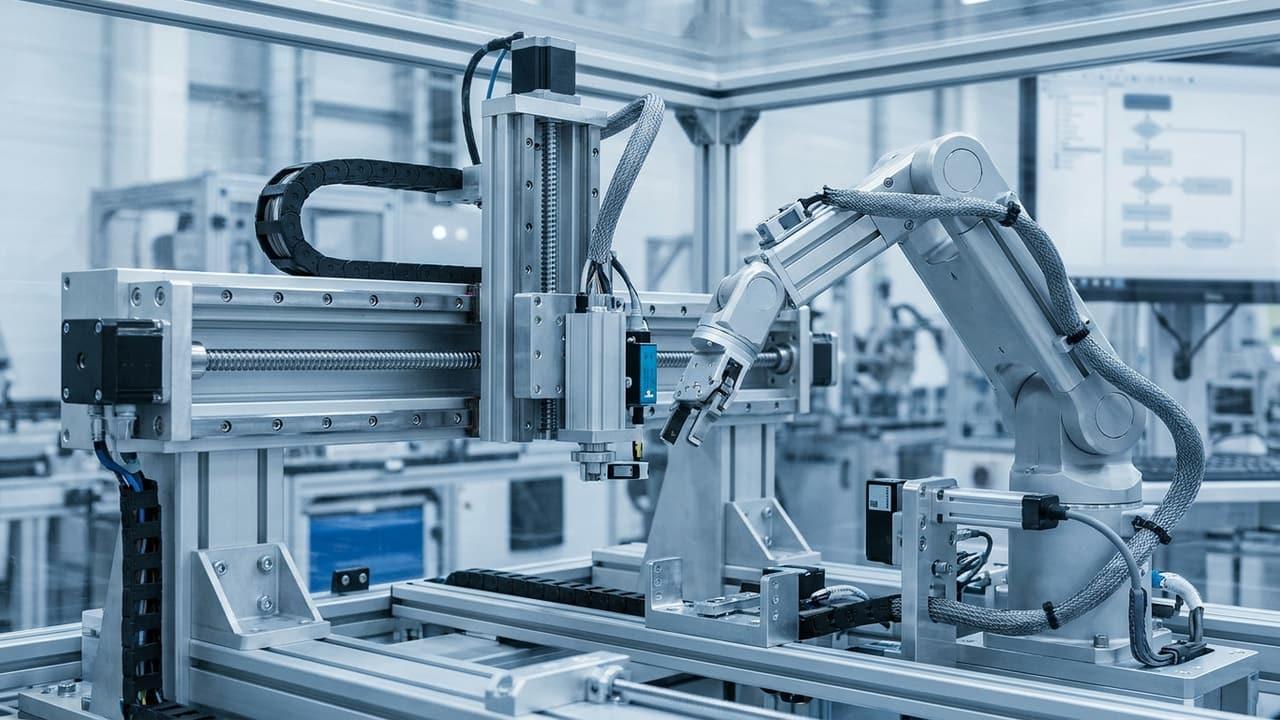
Linear motion systems are widely used to move products, tools, fixtures, and workpieces between different positions.
Typical applications include:
A customized linear module can be integrated directly into the machine structure.
Linear modules can provide controlled X, Y, or Z movement for pick-and-place systems.
A typical system may combine:
Linear Module + Servo Motor + Gripper + Vision System + PLC
The motion axis moves the product to the required position while the gripper performs the handling operation.
For high-cycle applications, stroke, speed, acceleration, payload, and cycle time should be considered together.
Long-travel linear axes can extend the working range of industrial robots.
A robot linear axis or 7th-axis system can allow a robot to travel between multiple workstations.
Potential applications include:
This can be particularly useful when one robot needs to serve multiple stations.
Precision linear motion is important for automated inspection.
A linear stage can move:
along a controlled path.
Applications include dimensional measurement, surface inspection, optical inspection, and automated testing.
Electronics manufacturing often requires compact and precise motion systems.
Linear motor modules, linear stages, and precision guides can be used in:
The required specifications depend heavily on acceleration, repeatability, cleanliness, payload, and environmental conditions.
Linear motion systems can provide synchronized movement in packaging and printing equipment.
Applications include:
Long-stroke belt-driven modules are often useful when relatively high-speed movement is required.
Linear motion components are also fundamental to machine tools.
Linear guides, ball screw modules, actuators, and other motion components can provide controlled movement for:
For these applications, rigidity, load capacity, accuracy, repeatability, and service life are important selection factors.
For a standard machine, an off-the-shelf product may be sufficient.
However, OEM equipment often has unique requirements.
A custom linear motion manufacturer can help adapt the motion system to the machine instead of requiring the machine to be redesigned around a standard component.
When comparing linear motion manufacturers, OEM customers should evaluate more than product catalogs.
Consider the following:
Does the manufacturer offer different motion technologies?
A broad product range makes it easier to select the appropriate solution for different applications.
Can the manufacturer modify stroke, dimensions, mounting, motor configuration, or carrier design?
Does the manufacturer understand automation applications rather than only supplying individual mechanical components?
Consider production quality, component consistency, assembly capability, and quality control.
For customized projects, engineering communication is important from initial specification through final production.
A typical custom project can begin with several basic parameters:
Based on these requirements, the manufacturer can recommend a suitable combination of linear module, guide, drive system, motor, and control components.
For complex systems, several linear axes can also be integrated into an XYZ linear motion system, Cartesian robot, or custom gantry system.
This approach is particularly valuable for automation equipment manufacturers that need repeatable solutions across different machine models.