As manufacturers continue to pursue higher productivity and smarter production processes, traditional belt conveyors often struggle to meet the demands of high-speed indexing, precise positioning, and multi-station automation. This is where the elliptical conveyor system has become a preferred solution for modern industrial production.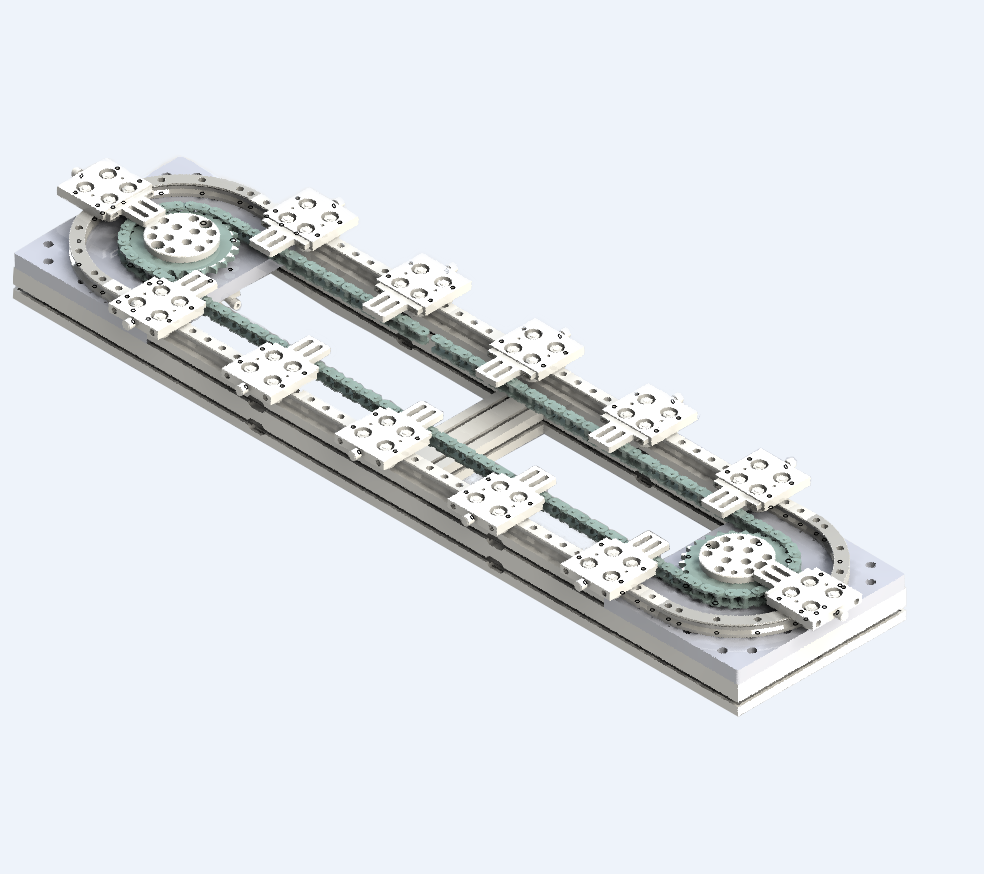
An elliptical conveyor system combines continuous pallet circulation with high-precision positioning, making it ideal for assembly, inspection, testing, dispensing, packaging, and robotic handling applications. For OEM machine builders and automation integrators, a custom-designed elliptical conveyor system offers superior flexibility, efficiency, and scalability.
In this article, we'll explain how elliptical conveyor systems work, their advantages, common applications, and why customized solutions deliver the greatest value for industrial manufacturers.
An elliptical conveyor system is a closed-loop pallet transfer system that moves workpieces around an oval or elliptical track. Each pallet stops precisely at designated workstations, allowing automated processes such as assembly, inspection, labeling, welding, or pick-and-place operations to be completed with high repeatability.
Unlike conventional belt conveyors, elliptical conveyors are designed for:
They are widely used in intelligent manufacturing environments where speed and precision are equally important.
An elliptical conveyor transports pallets using a precision chain or link-driven mechanism powered by servo motors.
A typical production cycle includes:
The entire system is synchronized with robots, vision systems, sensors, and PLC controllers to ensure smooth, continuous production.
One of the biggest advantages of an elliptical conveyor system is its ability to support fast production cycles.
Servo-controlled motion enables:
This significantly increases overall production capacity.
Precision indexing ensures that every pallet stops at exactly the same position.
Benefits include:
High repeatability minimizes product variation and improves manufacturing consistency.
Compared with traditional straight conveyors, an elliptical layout makes more efficient use of available factory space.
Its closed-loop design allows multiple workstations to operate within a compact footprint, making it ideal for high-density automation cells.
Elliptical conveyor systems integrate seamlessly with:
This flexibility simplifies the design of fully automated production lines.
Automation reduces manual handling, minimizes downtime, and improves production consistency.
The result is:
Ideal for:
High precision is essential in electronic manufacturing.
Suitable for:
Repeatable positioning helps ensure product quality.
Applications include:
The conveyor improves both speed and reliability.
Battery production requires:
Elliptical conveyors are increasingly used in lithium battery assembly lines.
Used for:
Automation increases throughput while maintaining quality.
| Feature | Elliptical Conveyor System | Traditional Belt Conveyor |
|---|---|---|
| Positioning Accuracy | High | Moderate |
| Indexing Capability | Excellent | Limited |
| Production Speed | High | Moderate |
| Repeatability | Excellent | Basic |
| Automation Integration | Excellent | Limited |
| Space Utilization | Efficient | Moderate |
For precision automation, an elliptical conveyor system delivers significantly better performance than a standard belt conveyor.
Every production line has unique technical requirements. A standard conveyor may not meet all process needs.
A custom elliptical conveyor system can be optimized for:
Designed to match specific product dimensions.
Configured according to production processes.
Customized to fit available factory space.
Engineered for lightweight or heavy-duty applications.
Optimized for target production output.
Compatible with robots, PLCs, vision systems, MES platforms, and industrial networks.
Customization ensures maximum production efficiency and long-term flexibility.
Before choosing a conveyor, engineers should evaluate:
Determine pallet and fixture requirements.
Influences conveyor structure and drive system selection.
Defines indexing precision requirements.
Determines cycle time and indexing speed.
Affects conveyor dimensions and workstation arrangement.
Choose a scalable design that supports future production growth.
Working with an experienced manufacturer ensures the system meets both current and future requirements.
A modern elliptical conveyor typically includes:
Provides smooth, stable pallet movement with long service life.
Delivers accurate indexing, speed control, and synchronization.
Securely transport workpieces between stations.
Ensure repeatable stopping accuracy for automated operations.
Supports:
Together, these components create a reliable and efficient automation platform.
As factories become smarter, elliptical conveyor systems continue to evolve with advanced technologies, including:
These innovations help manufacturers improve efficiency while reducing operating costs and unplanned downtime.
An experienced manufacturer offers more than equipment—they provide complete engineering support.
Professional services include:
Choosing the right supplier reduces project risk and ensures optimal system performance.