In modern industrial automation, many production processes require multiple components to move simultaneously while maintaining or changing the distance between them. A conventional linear actuator can move a component along a straight path, but applications involving adjustable spacing between multiple working positions often require a more specialized motion solution.
A variable pitch linear actuator is designed to address this requirement. It enables coordinated linear movement while adjusting the relative distance between multiple sliders, grippers, fixtures, or workpieces. This makes it useful for automated pick-and-place equipment, electronic component handling, multi-station assembly, packaging machinery, and other applications that require flexible product positioning.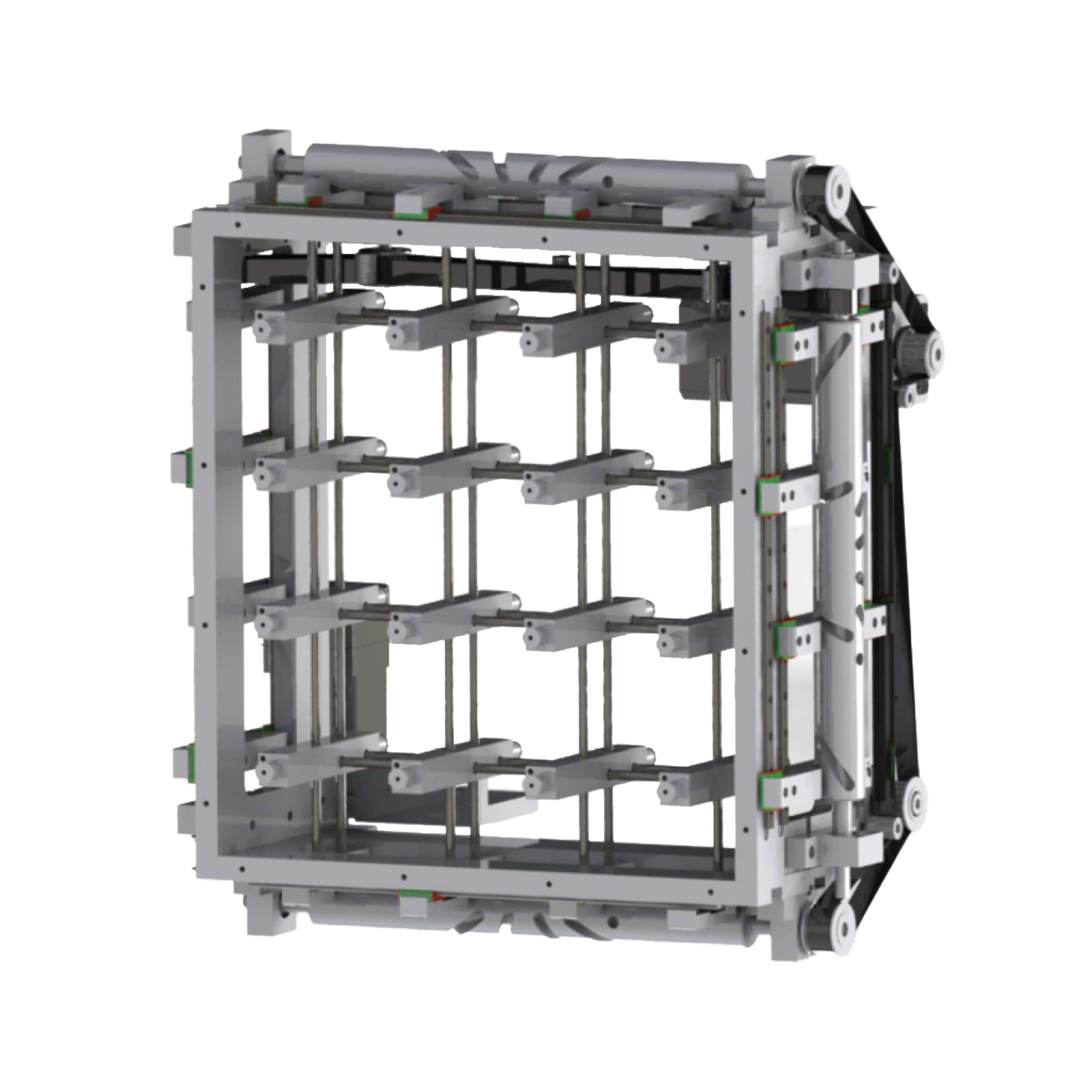
For OEM equipment manufacturers and automation system integrators, selecting the right variable pitch actuator can help simplify handling processes, improve machine integration, and support customized production requirements.
A variable pitch linear actuator is a specialized linear motion mechanism designed to adjust the spacing between multiple moving elements.
Unlike a standard linear actuator, which generally moves one rod or carriage along a straight axis, a variable pitch linear actuator coordinates multiple positioning points so that their relative spacing can be changed according to the production requirements.
For example, an automated machine may receive four components arranged at a pitch of 20 mm. However, the next processing station may require a pitch of 60 mm. A variable pitch actuator can be configured to change the spacing between the four working positions during the transfer process.
The system may use a mechanical transmission mechanism, a servo-controlled arrangement, or a combination of both, depending on the required motion flexibility.
Typical characteristics include:
Adjustable spacing between multiple sliders or working positions.
Coordinated movement of multiple grippers or fixtures.
Customizable pitch range and slider quantity.
Integration with servo motors and motion controllers where required.
Flexible installation dimensions and mechanical configurations.
Suitability for automated multi-product handling processes.
The achievable pitch range, payload, speed, and positioning repeatability depend on the actuator's mechanical design and control configuration.
The working principle of a variable pitch linear actuator is based on coordinating the movement of multiple positioning elements to achieve a required spacing arrangement.
Depending on the design, the actuator may use mechanical linkages, cams, screws, belts, or independently controlled drive units to generate the pitch-adjustment movement.
A typical operating process involves four stages.
Multiple sliders, grippers, or fixtures begin at a predefined pitch that matches the incoming workpieces.
For example, four products may enter the machine at a spacing of 25 mm.
The motor or mechanical drive system activates the pitch-adjustment mechanism. The moving elements begin to travel according to the designed mechanical relationship or programmed motion sequence.
The distance between the sliders changes from the initial pitch to the target pitch.
Depending on the design, the movement can be symmetrical, synchronized, or individually controlled. The system may increase or decrease the spacing according to the requirements of the next production station.
The sliders reach their target positions, allowing the grippers or fixtures to transfer, assemble, or release the workpieces at the required spacing.
After completing the operation, the actuator can return to its initial configuration or move to another programmed position.
Practical example:
An automated handling system needs to transfer six components from a feeding station to an assembly station.
Initial pitch: 30 mm.
Required pitch: 70 mm.
Number of working positions: 6.
A suitably designed variable pitch linear actuator can coordinate the six positions and adjust the spacing from 30 mm to 70 mm during the operating cycle.
This can reduce the need for separate spacing-adjustment mechanisms and individual handling operations.
The actual adjustment time and positioning performance must be evaluated according to the slider mass, pitch range, transmission design, and required cycle time.
A variable pitch linear actuator combines mechanical transmission, guided movement, and a drive or control system.
|
Component |
Main Function |
|---|---|
|
Structural frame |
Supports the actuator and maintains mechanical alignment |
|
Linear guide system |
Guides slider movement and supports the specified loads |
|
Multiple sliders |
Carry grippers, fixtures, or workpieces |
|
Pitch-adjustment mechanism |
Changes the relative distance between sliders |
|
Drive mechanism |
Transmits the required motion to the moving elements |
|
Motor |
Provides the power for movement in powered configurations |
|
Controller |
Coordinates motion and position commands when electronically controlled |
|
Sensors and feedback devices |
Monitor position and operating conditions where required |
The component arrangement varies between products. Mechanically synchronized systems may use one drive to coordinate multiple sliders, while servo-controlled designs may use multiple drive units to achieve more flexible positioning.
When selecting an actuator, it is important to understand whether the pitch is mechanically fixed by the transmission geometry or electronically adjustable through the control system.
The primary advantage of a variable pitch linear actuator is its ability to change the distance between multiple working positions.
This is useful when products move between different processing stations with different spacing requirements.
Instead of designing separate mechanisms for every spacing operation, manufacturers can use one coordinated system to adjust the product arrangement.
Variable pitch actuators can coordinate multiple sliders, grippers, or fixtures during one operating sequence.
This is particularly valuable for machines that handle several components simultaneously. Depending on the design, coordinated movement can help maintain consistent spacing and reduce unnecessary individual positioning operations.
Some variable pitch systems support multiple pitch settings, allowing equipment to handle different product sizes or production configurations.
This can be beneficial for manufacturers developing machines that need to accommodate product changes or multiple production specifications.
The available flexibility depends on the actuator's mechanical structure and control architecture.
By combining multiple positioning functions into a coordinated mechanism, a variable pitch actuator may reduce the need for separate spacing-adjustment units.
This can help simplify machine layouts and reduce the number of independent motion components.
However, the actual space savings depend on the required pitch range, slider quantity, and overall machine arrangement.
Different automation machines have different requirements for slider quantity, spacing, payload, travel distance, and installation dimensions.
A custom variable pitch actuator can be designed around these parameters to match the equipment's mechanical structure and production sequence.
Variable pitch linear actuators are commonly considered for automated processes where multiple workpieces need to be repositioned or transferred with adjustable spacing.
In multi-head pick-and-place equipment, several grippers or suction heads may need to pick up products at one spacing and place them at another.
A variable pitch actuator can coordinate the positions of multiple handling heads, helping the machine adapt to different product arrangements.
Typical applications include electronic component handling, automated assembly, and precision loading and unloading.
Electronic manufacturing equipment often handles small components that require controlled positioning and consistent spacing.
Variable pitch mechanisms can help transfer multiple components between feeding, inspection, and assembly stations where the required spacing may differ.
The actuator should be selected according to component dimensions, gripping method, payload, and positioning requirements.
Packaging machines may need to arrange multiple products before grouping, sorting, filling, or placing them into trays.
A variable pitch linear actuator can adjust the spacing between products to match the packaging layout.
For example, products arriving close together on a conveyor may need to be separated before entering individual packaging positions.
Tray-loading equipment often requires products to be arranged according to predefined positions.
A variable pitch actuator can coordinate multiple grippers and adjust their spacing before placing components into tray pockets.
This can be useful in electronics, precision components, and automated material handling.
In automated assembly equipment, different stations may require different component arrangements.
A variable pitch mechanism can adjust the spacing between multiple fixtures or workpieces during transfer, supporting coordinated movement between processing stages.
Although both products provide linear motion, their primary functions are different.
|
Comparison |
Variable Pitch Linear Actuator |
Standard Linear Actuator |
|---|---|---|
|
Primary function |
Adjusts spacing between multiple positioning points |
Produces linear movement along an axis |
|
Moving elements |
Usually multiple coordinated sliders or fixtures |
Commonly one rod or carriage |
|
Pitch adjustment |
Core function |
Not normally included |
|
Motion control |
May coordinate position and relative spacing |
Primarily controls linear position and speed |
|
Mechanical structure |
Usually more specialized |
Generally simpler |
|
Application focus |
Multi-product handling and spacing adjustment |
Pushing, pulling, lifting, and positioning |
|
Customization |
Pitch range, slider count, synchronization, and stroke |
Stroke, thrust, speed, mounting, and drive type |
A standard linear actuator is suitable for conventional linear movement. A variable pitch actuator is more appropriate when multiple working positions need to change their relative spacing.
In some automation systems, both can be used together. A standard linear module can provide the main transfer axis, while the variable pitch mechanism adjusts the spacing between products or grippers.
Choosing a suitable variable pitch linear actuator requires more than specifying the desired pitch. Engineers should consider the complete machine operation and mechanical requirements.
1. Pitch adjustment range
Define the minimum and maximum spacing required. Confirm whether the actuator needs fixed pitch settings or multiple adjustable positions.
2. Number of sliders
Specify how many sliders, grippers, or fixtures need to move together. This affects the mechanism's geometry, overall dimensions, and moving mass.
3. Payload capacity
Calculate the weight of each workpiece, gripper, and fixture. Also consider the total moving mass and any external forces or moments.
4. Stroke and installation dimensions
Determine the required travel distance, overall actuator length, mounting arrangement, and available machine space.
5. Motion speed and cycle time
Specify the required pitch-adjustment time, transfer speed, acceleration, deceleration, and total production cycle.
6. Positioning accuracy and repeatability
Define the required final pitch and the consistency needed across repeated operations. Consider mechanical backlash, transmission tolerances, feedback devices, and control settings.
7. Drive and control configuration
Determine whether the application is better suited to a mechanically synchronized mechanism or a servo-controlled system. Confirm motor specifications, controller compatibility, and sensor requirements.
Providing these parameters to the manufacturer helps ensure that the actuator design matches the actual production process.
Standard products may not always satisfy the requirements of specialized automation equipment. OEM manufacturers often need customized variable pitch linear actuators to match their product dimensions, working positions, and machine layouts.
Custom solutions may include:
Customized minimum and maximum pitch.
Different numbers of sliders or working positions.
Customized stroke and overall dimensions.
Mechanical synchronization or servo-controlled movement.
Motor and transmission configuration.
Customized mounting interfaces.
Integration with grippers, sensors, PLCs, and other motion systems.
For example, a machine handling four products may require a different slider arrangement and pitch range from equipment handling eight products. The mechanism should be designed around the actual workpiece layout and required operating sequence.
KNK Technology provides linear motion products and customized motion solutions for industrial automation. For OEM projects involving multi-position handling or adjustable spacing, the actuator configuration should be evaluated according to the pitch range, slider quantity, payload, cycle time, and control requirements.
Visit KNK Technology to explore linear motion solutions for custom automation equipment.
Its main purpose is to adjust the spacing between multiple moving elements, such as sliders, grippers, fixtures, or workpieces, during an automated production process.
Yes. Many designs are intended to coordinate several products or working positions in one motion sequence. The number of products depends on the actuator's mechanical structure, payload capacity, and available working space.
Not necessarily. Some systems use mechanical synchronization, while others use servo motors and electronic motion control. The choice depends on the required pitch flexibility and motion sequence.
Yes. Custom variable pitch solutions can be designed around the required minimum and maximum spacing, slider quantity, stroke, and installation dimensions, subject to mechanical feasibility.
The terms are sometimes used interchangeably in industrial automation. Both may describe systems that adjust spacing between multiple positioning points. The exact product structure and capabilities should be confirmed from the manufacturer's technical specifications.