Industrial conveyor systems play an important role in modern manufacturing and industrial automation. They are designed to move products, components, materials, and workpieces between different processing stations, helping manufacturers improve production flow and reduce manual material handling.
From simple material transfer to complex automated assembly lines, industrial conveyor systems are available in different mechanical configurations to meet specific production requirements.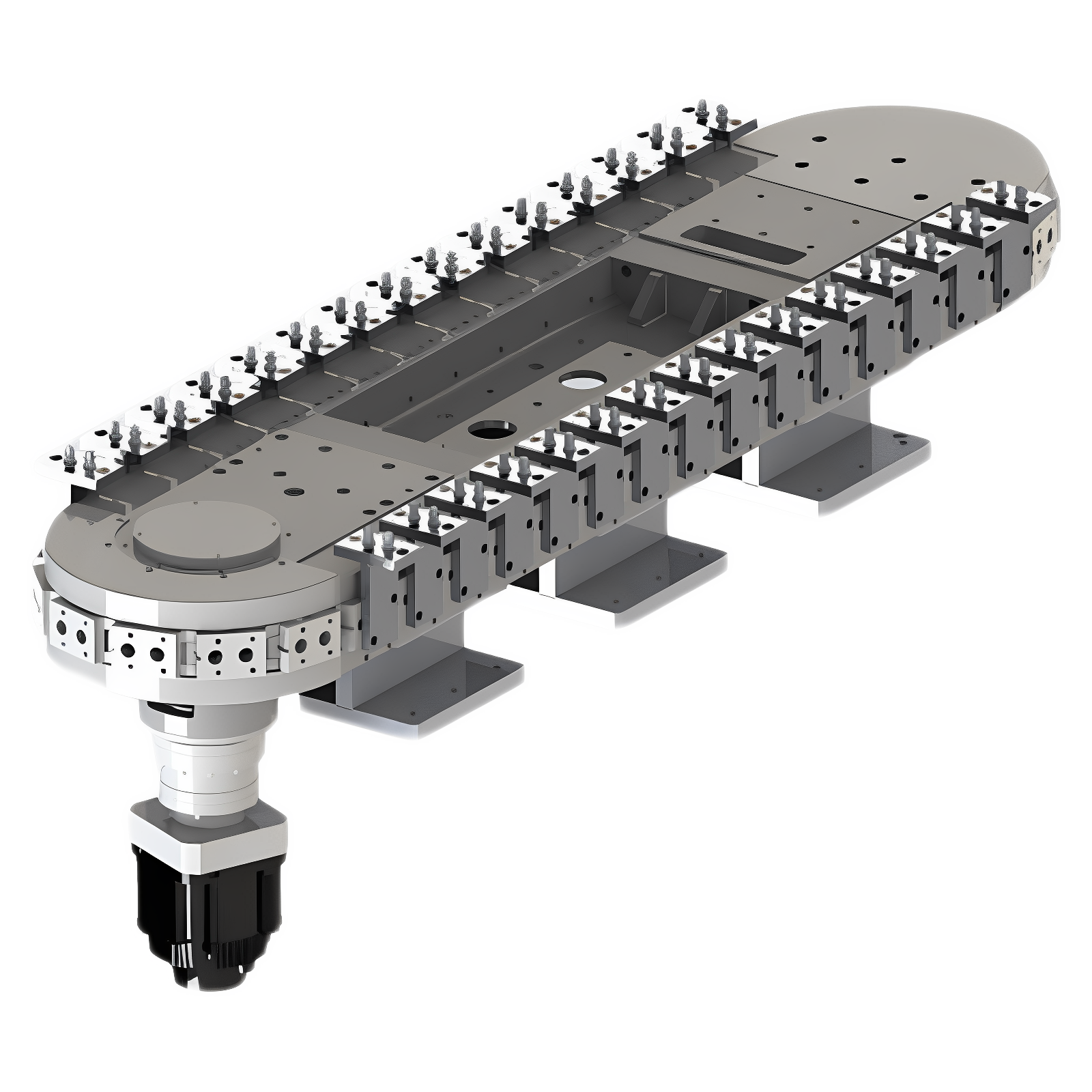
Common types include belt conveyors, roller conveyors, chain conveyors, overhead conveyors, and precision indexing conveyor systems. Each type offers different advantages depending on the product dimensions, load capacity, production speed, positioning requirements, and factory layout.
For equipment manufacturers and factory automation projects, selecting the right industrial conveyor system involves more than choosing a conveyor based on its appearance. The system must match the production process, equipment structure, and required operating performance.
This article explains the main types of industrial conveyor systems, their applications, important selection factors, and the benefits of customized conveyor solutions.
Industrial conveyor systems are mechanical equipment designed to transport materials or workpieces along a predefined path.
They are widely used in manufacturing facilities, assembly lines, packaging plants, logistics operations, and automated production systems.
A typical industrial conveyor system consists of several main components:
Conveyor frame and supporting structure
Conveyor chain, belt, roller, or other transmission mechanism
Drive motor and transmission components
Guide rails and positioning components
Sensors and control devices
Safety protection and supporting accessories
Depending on the production requirements, an industrial conveyor system can operate continuously or move products intermittently between specific processing stations.
For example, a continuous conveyor transports products from one location to another without stopping at every station. An indexing conveyor moves workpieces to predetermined positions and pauses for operations such as assembly, inspection, or processing.
The appropriate configuration depends on the production cycle and the required level of positioning control.
Different industrial conveyor systems are designed for different material handling and production applications.
Understanding their structures and operating characteristics helps manufacturers select a suitable solution.
Belt conveyor systems use a continuous belt supported by rollers or a conveyor frame to transport materials.
They are commonly used for:
General material handling
Packaging and sorting
Product transfer
Warehouse operations
Production line transportation
Belt conveyors are suitable for many products and can be designed in different lengths and widths. However, applications requiring precise positioning or complex multi-station indexing may need additional positioning mechanisms.
Roller conveyor systems transport products using a series of rotating rollers.
Depending on the design, they can be gravity-driven or powered by motors.
Common applications include:
Carton transportation
Pallet handling
Warehouse material movement
Assembly line transfer
Loading and unloading operations
Roller conveyors are often used for products with relatively stable bottom surfaces. Product dimensions, weight distribution, and transfer conditions should be considered during system design.
Chain conveyor systems use industrial chains to move products or workpiece carriers along a defined path.
They are suitable for applications involving relatively heavy loads, dedicated workpiece fixtures, or customized production line layouts.
Common applications include:
Industrial assembly lines
Automotive component handling
Manufacturing equipment
Pallet transfer systems
Automated production lines
Chain conveyors can be designed with different chain structures, guide arrangements, and workpiece carriers to match specific operating requirements.
Precision chain conveyor systems are designed for applications requiring controlled workpiece transportation and positioning.
They are often used in automated assembly and multi-station manufacturing equipment.
Depending on the mechanical structure and positioning mechanism, these systems can support:
Repeated workpiece transfer
Multi-station production
Controlled indexing movement
Workpiece positioning
Automated assembly operations
For applications requiring higher positioning performance, the conveyor may be integrated with mechanical locating devices, sensors, or secondary positioning units.
The required positioning accuracy should be evaluated based on the actual application and the complete system configuration.
Oval and circular conveyor systems use a closed-loop conveying structure to move workpieces through multiple stations.
Unlike straight conveyor lines, their closed-loop design allows products to circulate through different processing positions within a relatively compact layout.
Typical applications include:
Automated assembly equipment
Multi-station production systems
Precision component processing
Product inspection and testing
Automated loading and unloading
An oval conveyor system is suitable when multiple stations need to be arranged along an elliptical or elongated closed-loop path.
A circular conveyor system is more appropriate for applications requiring workpiece circulation around a central area.
The selection depends on the equipment layout, number of stations, workpiece dimensions, and production cycle.
Indexing conveyor systems move products in predefined increments rather than continuously.
The conveyor advances a workpiece to a specific position and stops for a production operation.
Typical applications include:
Automated assembly
Component insertion
Inspection and testing
Mechanical processing
Multi-station production
Indexing movement is useful when production operations need to be performed at fixed stations.
Depending on the required accuracy and cycle time, the system may use servo drives, mechanical indexing mechanisms, sensors, or additional locating structures.
Although conveyor structures vary, most industrial conveyor systems follow a similar operating process.
Products or components are placed onto the conveyor manually or through automated loading equipment.
Depending on the application, they may be positioned directly on the conveyor or installed on dedicated pallets and fixtures.
A motor drives the conveyor's transmission mechanism.
Depending on the conveyor type, movement is generated through belts, chains, rollers, or other mechanical components.
The conveyor transports workpieces along a predefined path.
For automated production lines, sensors or positioning mechanisms can be used to identify workpiece locations and coordinate movement between stations.
Products may pass through multiple operations, including:
Assembly
Inspection
Testing
Processing
Packaging
Sorting
For indexing conveyor systems, the workpiece stops at a designated station while the corresponding operation is performed.
After completing the production process, workpieces are transferred to the next stage or unloaded from the conveyor.
In closed-loop conveyor systems, empty carriers may continue circulating to the loading position for reuse.
Industrial conveyor systems are widely used across different manufacturing sectors.
Automotive production involves the transportation and assembly of various components.
Industrial chain conveyors, roller conveyors, and specialized automated conveyor systems can be used to move workpieces between manufacturing and assembly stations.
Electronics production often requires controlled transportation of small components and assemblies.
Suitable conveyor systems can support component handling, assembly, testing, and inspection processes.
For applications requiring precise workpiece positioning, precision conveyor systems can be integrated with automated fixtures and positioning devices.
Packaging production lines use conveyor systems to transfer products between filling, sealing, labeling, inspection, and packaging stations.
Belt conveyors and indexing conveyors are common options, depending on the product and production process.
Medical equipment production may involve multiple assembly and inspection procedures.
Customized conveyor systems can help organize workpiece movement between different production stations.
The design should account for the applicable cleanliness, material, and operating environment requirements.
Some semiconductor and precision equipment applications require carefully controlled workpiece handling.
Depending on the production process, suitable conveyor systems may be integrated with precision positioning units, linear motion modules, and automated inspection equipment.
Special environmental and cleanliness requirements should be evaluated during system selection.
Conveyor systems are widely used for product transfer, sorting, packaging, and processing in food production facilities.
Material selection, cleaning requirements, hygiene standards, and environmental conditions are important factors when designing conveyor equipment for these applications.
Industrial conveyor systems can improve production flow by reducing the need for repeated manual transportation between workstations.
|
Comparison |
Manual Material Handling |
Industrial Conveyor Systems |
|---|---|---|
|
Transportation |
Relies on manual operations |
Mechanically driven |
|
Production flow |
Depends on operator coordination |
Can follow a predefined route |
|
Production consistency |
May vary between operations |
Can be standardized through system control |
|
Material transfer |
Often requires repeated handling |
Supports continuous or indexed movement |
|
Automation integration |
Limited |
Can connect with automated equipment |
|
Production layout |
Depends on manual handling routes |
Can be designed around the production process |
However, conveyor systems are not automatically suitable for every production environment.
For low-volume operations or frequently changing workpiece routes, manual handling or flexible transport equipment may remain practical options.
The decision should be based on production volume, labor requirements, equipment investment, and long-term operating costs.
Selecting an appropriate industrial conveyor system requires a detailed understanding of the production process.
The following factors should be considered.
The conveyor must be suitable for the size, shape, and weight of the transported products.
For systems using pallets or dedicated fixtures, the dimensions and loading positions of these carriers should also be confirmed.
Consider the available factory space and the arrangement of processing stations.
Common layouts include:
Straight-line conveyor layouts
L-shaped conveyor layouts
U-shaped conveyor layouts
Oval conveyor layouts
Circular conveyor layouts
Closed-loop conveyor layouts
The layout should support an efficient production flow and allow sufficient space for maintenance and operator access.
Determine the required conveying speed and production cycle time.
Continuous conveyors are suitable for uninterrupted transportation, while indexing conveyors are more appropriate when products need to stop at specific processing positions.
General transportation applications may not require high positioning accuracy.
However, automated assembly, inspection, and precision processing often require additional positioning mechanisms or precision conveyor structures.
It is important to distinguish between the conveyor's transportation accuracy and the positioning accuracy achieved by secondary locating equipment.
Environmental conditions can affect conveyor design and component selection.
Consider:
Operating temperature
Dust and contamination
Humidity
Lubrication requirements
Corrosion exposure
Cleaning requirements
Continuous operating conditions
The selected materials, drive components, and protection structures should match the working environment.
A well-designed conveyor system should allow convenient inspection, lubrication, component replacement, and routine maintenance.
For continuous production lines, maintenance accessibility is an important factor in long-term operating efficiency.
Standard conveyor equipment can meet many general transportation requirements. However, specialized automation equipment often requires a conveyor system designed around the machine's structure and production process.
Custom industrial conveyor systems can be developed according to specific requirements.
Common customization options include:
Conveyor length and width
Straight or closed-loop layouts
Oval or circular structures
Chain and transmission configurations
Workpiece carrier and pallet design
Motor and drive configuration
Conveying speed and cycle time
Positioning and indexing requirements
Integration with robotic and automated equipment
For example, an automated assembly machine may require multiple processing stations arranged along an oval conveyor path.
A customized precision conveyor can be designed to circulate workpieces between these stations while coordinating transportation and positioning operations.
For OEM equipment manufacturers, a properly designed conveyor system can help simplify machine integration and improve compatibility with the overall production process.
Precision circular conveyor systems are a specialized type of industrial conveyor system designed for closed-loop workpiece transportation.
They are particularly useful when production equipment requires multiple stations arranged along a continuous circulation path.
Compared with a simple straight conveyor, a closed-loop structure allows workpieces to circulate through several stations without requiring a separate return conveyor layout.
Depending on the mechanical structure, precision circular conveyor systems can offer:
Closed-loop workpiece transportation
Multiple processing stations
Continuous or indexed movement
Integration with automated assembly equipment
Flexible station arrangement
Customized workpiece carriers
Mechanical positioning solutions
KNK Technology develops precision conveying solutions for industrial automation applications, including chain-based oval and circular conveyor systems.
For equipment manufacturers, important design considerations include the number of stations, workpiece weight, conveyor dimensions, operating speed, positioning requirements, and installation environment.
These parameters should be evaluated together to determine the appropriate conveyor configuration.
KNK Technology specializes in industrial linear motion products and precision conveying solutions for automation equipment.
Its product range includes:
Precision circular conveyor systems
Chain oval conveyor systems
Precision chain conveyors
Linear modules
Electric cylinders
Linear motor modules
Gear rack linear modules
PPU cam pick-and-place units
KNK's precision conveying solutions are designed for applications requiring organized workpiece transportation and integration with automated production equipment.
For OEM customers, conveyor configurations can be evaluated according to the machine layout, workpiece requirements, production cycle, and positioning needs.
When discussing a customized industrial conveyor system, providing the following information can help the engineering team understand the project:
Workpiece dimensions and weight
Required conveyor layout
Number of processing stations
Required conveying speed
Production cycle time
Positioning requirements
Available installation space
Operating environment
Technical drawings, equipment layouts, or 3D models can also help with the initial evaluation.
If you are developing an automated production line and need a customized industrial conveyor system, contact KNK Technology to discuss your project requirements.
Common types include belt conveyors, roller conveyors, chain conveyors, overhead conveyors, precision chain conveyors, indexing conveyors, and oval or circular conveyor systems.
The appropriate type depends on the product, load, conveying distance, production process, and positioning requirements.
A belt conveyor uses a continuous belt to transport products, while a chain conveyor uses a chain-based transmission mechanism.
Belt conveyors are commonly used for general material transportation. Chain conveyors are often selected for applications requiring dedicated workpiece carriers, specific mechanical layouts, or heavier-duty transportation.
An indexing conveyor moves workpieces in predefined increments and stops them at specific positions.
It is commonly used in automated assembly, inspection, testing, and multi-station production equipment.
An oval conveyor system uses a closed-loop structure with two curved ends connected by straight sections.
It allows workpieces to circulate through multiple processing stations and is commonly used in automated assembly and production equipment.
An oval conveyor typically has an elongated closed-loop layout, while a circular conveyor follows a more compact circular path.
The choice depends on available installation space, station arrangement, workpiece movement, and production requirements.
Yes. Conveyor systems can be customized in terms of dimensions, layout, transmission structure, workpiece carriers, drive configuration, speed, and positioning requirements.
Customized solutions are particularly useful for OEM equipment manufacturers and specialized automation projects.
Evaluate the manufacturer's engineering capabilities, product range, customization experience, manufacturing quality, technical support, and ability to understand your production requirements.
A suitable manufacturer should be able to recommend a conveyor structure based on the actual application rather than simply offering a standard product.
Prepare the workpiece dimensions and weight, conveyor layout, required speed, number of stations, production cycle, positioning requirements, installation space, and operating environment.
Providing drawings or 3D models can help the manufacturer evaluate the project and prepare a more accurate proposal.